I, Human
Humans are an egotistic species. Ancient writers considered humans to be created in the image of the gods, destined to rule all other entities. We humans have not one, but two major fields of study devoted to ourselves and named accordingly (
anthropology and the
humanities). Pick up a book at random and its main topic is likely to be humans (or at least anthropomorphized non-humans).
Yet we are also an outward-looking species. Alone among the life forms of Earth, we regard the skies, the deep, the land. We observe what is, fashion tests to determine how it came to be, and speculate on where things are going. We are self-centered, but our curiosity about things other than ourselves is boundless.
One of the best examples of this apparent paradox lies with systematics, the naming and organizing of life. And no one person illustrates it better than the founder of systematics, Swedish botanist Carl Linnaeus.
Out of Chaos, Order
Carl Linnaeus lived during the 18th century, a time when science, in its modern meaning, was still emerging from what had been called "natural philosophy". The term "biology" had not even been invented yet. Microbes and cells had been discovered, but things like evolution, germ theory, genetics, biochemistry, etc. were a long way off. The study of life was largely a chaotic mess.
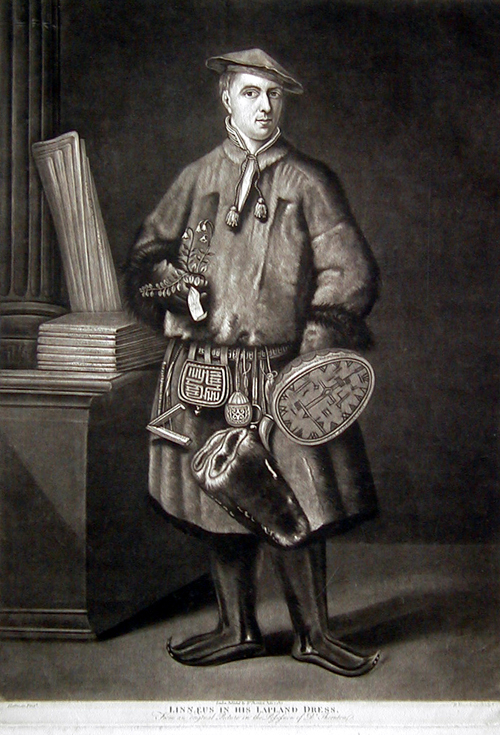 |
| Carl Linnaeus as a young adventurer, dressed in Sámi clothing, painted by Martin Hoffman. |
Enter the organizer: Linnaeus observed natural entities and saw order, not chaos. He began to arrange animals, plants, and minerals into hierarchical groups, first in his notes, then in pamphlets, and finally as a series of volumes,
Systema Naturae. He was not the only naturalist of his time to do this, but he went further than most, and enjoyed more success. Unlike many scholars, his brilliance was recognized in his own time.
Perhaps nobody recognized it more than Linnaeus himself. True to his species, he had a healthy ego. "Deus creavit, Linnaeus disposuit," he was fond of saying: God created, Linnaeus organized. He thought enough of himself to slave over his autobiography almost as much as his systematic work. And he thought enough of his species to give it the name
Homo sapiens—"wise human"—and place it in an order called
Primates—"primary ones".
But religious leaders of the day took a different view of
Primates. To them, the idea that humans could possibly be grouped alongside such lowly creations as lemurs, apes, and monkeys (and bats, originally included in
Primates but long since removed) was sacrilege. (Compounding this, "primate" is a religious title as well.) The Roman Catholic Papa Clement XIII banned Linnaeus's books outright in 1758 (although in 1774 Papa Clement XIV actually fired his Professor of Botany for deficient knowledge of Linnaeus's system!) (Soulsby 1993:39). Even Linnaeus's own religious leader, the Lutheran Bishop of Uppsala, considered him impious (Aczel 2007), although this was no bar to Linnaeus being ennobled later on, whereafter he was known as Carl von Linné.
 |
| Carl von Linné in 1775, painted by Alexander Roslin |
Privately, Linnaeus confessed that he would have liked to go even further in arranging humans with other members of Order
Primates. He saw no anatomical reason not to include apes, monkeys, and humans in the same
genus (which was a much broader category as he used it than as we use it today), let alone the same order. The only reason he did not name us
Simia sapiens was because he feared theological backlash. (Linnaeus 1747)
So here we have a man who saw his species as "wise" and "primary", but recognized that it did not stand apart from other species. Subsequent biological research has upheld our connection to other living things. Ethologists have found that other species use tools, communicate vocally, and even domesticate other life forms. Geneticists have discovered that our DNA is little different from that of a chimpanzee. Paleontologists have found series of extinct species showing that we evolved from ancestors that we share with other animals. Phylogenetically, his inclination was correct—we are one of many kinds of monkey.
Today we struggle to find things that make humans unique. There are still a few—for one thing, no other terrestrial species has attempted to catalogue its fellow life forms. Ironically, this effort, which brings us into the fold with other life forms, also sets us apart.
Naming the Animals
"And Yahweh [of the El Gods] sculpted from the ground every living thing of the field and every flier of the sky-waters. And he brought the Human in to see how he would call them. And whatever the Human called it, that was that living animal's name. And the Human called names to all the beasts, to the fliers of the sky-waters, and to every living thing of the field."
—Anonymous Yahudi, Bereshith 2:19–20a (my translation)
Modern zoological nomenclature, as governed by the International Commission on Zoological Nomenclature according to the
International Code of Zoological Nomenclature (
ICZN), descends directly from Linnaeus's
Systema Naturae. Many of his groupings seem quaint or even laughable today, but, on the other hand, many don't, and a large number of the names he coined are still in use (albeit often for somewhat different groups). The tenth edition of
Systema Naturae, published in 1758, is considered one of the founding works of zoological nomenclature (along with Carl Alexander Clerck's lesser-known 1757 work,
Aranei Suecici ["Swedish Spiders"]). By the
ICZN's rules, these are the earliest works to contain valid zoological names.
The
ICZN's way of doing things is a bit different from that of Linnaeus and other early systematists. In some respects this may be regrettable (e.g., the tying of names to ranks has led to much nomenclatural instability—in Linnaeus's time names were free to be ranked however the systematist saw fit, without any spelling change required [de Queiroz 2005]). In other ways, there has been improvement. One notable improvement is the mandating of
type specimens.
In Linnaeus's works, names are paired with diagnoses—descriptions of the entities which the name signifies. But diagnoses are an unstable way to define biological groups. They may be too general, bringing unrelated forms into the same group. They may be too specific, excluding forms which should rightly belong. Sometimes they are flat-out wrong. Whatever the case, they are constantly revised in the literature.
What biological nomenclature needed was a way of anchoring definitions. Thus, the
ICZN (as well as other nomenclatural codes) uses the concept of a
type, one entity which "sets the standard" for the entire group. One specimen (a specimen being some object that has been catalogued within a collection) is selected as the standard-bearer for each species name. There are various types of types in zoological nomenclature, but the most important one is the
holotype, the one specimen that anchors the name. Other individuals may be included or excluded as the systematist sees fit, but the one represented by the holotype must remain. (Note that, as practiced, this is different from the Platonic concept of an archetype, in that the holotype need not be a "typical" specimen. That concept is too subjective to be useful in science.)
The Human Holotype
The requirement that zoological names must have a holotype was not grandfathered in, or too many old names would have been invalidated. Instead, provisions were made such that subsequent authors could select a holotype if the original author did not. There are certain restrictions on this, set up to guarantee that the holotype is something that the original author would have included.
When Linnaeus named
Homo sapiens, he diagnosed it much more succinctly than usual.
"Homo, nosce te ipse," "H
OMO nosce Te ipsum," he wrote: "H
UMAN know yourself." Nothing further needed, at least at the time.
In 1959, in honor of the tenth edition of
Systema Naturae's 200
th anniversary, W. T. Stearn wrote a commemorative article that, among other topics, addressed the lack of a holotype specimen for
Homo sapiens:
"Since for nomenclatorial purposes the specimen most carefully studied and recorded by the author is to be accepted as the type, clearly Linnaeus himself, who was much addicted to autobiography, must stand as the type of his Homo sapiens!"
Although stated jokingly, this meets the
ICZN's requirements for the designation of a type specimen. Linnaeus's remains, interred at the Uppsala Dome-Church, are the standard-bearer for the species
Homo sapiens (and, by proxy, Genus
Homo, Family Hominidae, etc.). A fitting tribute to his brilliance ... and his ego.
The Mangani Holotypes
Like any good human, I am fascinated by my own species. I spend much of my spare time studying our origins. It's tough going at times, because many people are fascinated by the same topic, and so there is a huge wealth of hypotheses, ranging from crackpot to well-substantiated. On one hand, the wealth of material is great, but, on the other hand, it's hard to sort out the solid ideas from the less solid. In short, it's a chaotic mess.
I am no Linnaeus (and I'm sure he would agree), but I like to organize my thoughts. So this is the first post in a series where I will take a look at what anchors we do have in this sea of confusion. One by one, I intend to look at each holotype specimen within the human-chimpanzee group, which I informally call "mangani", as explained in
an earlier post.
I haven't decided on a particular order, but in many ways it seems that the most apt way to begin is with the first species to be named.
Carl Linnaeus (Uppsala domkyrka)
| Collection | Uppsala domkyrka, Uppsala, Sweden (Sverige), Europe |
|---|
| Name | Carl Linnaeus |
|---|
| Other Names | Carolus Linnaeus (Latin)
Carl von Linné (after ennoblement)
Carolus von Linné (Latin, after ennoblement)
L. (standard abbreviation in botanical literature) |
|---|
| Remains | interred corpse |
|---|
| Geography | born in Älmhult, Småland, Sweden (Sverige), Europe
died in Uppsala, Sweden (Sverige), Europe |
|---|
| Chronology | born 1707 CE May 23
died 1778 CE January 10 |
|---|
| Sex | male |
|---|
| Age | 71 years |
|---|
| Height | ~1.8m? ~1.6–1.7m? |
|---|
| Typified Taxa Names |
Species Homo sapiens Linnaeus 1758 [holotype]
Superspecies Homo (sapiens) Linnaeus 1758 [holotype]
Subspecies Homo sapiens sapiens Linnaeus 1758 [holotype]
Homo sapiens typifies:
Genus Homo Linnaeus 1758
Subgenus Homo (Homo) Linnaeus 1758
Homo typifies:
Superfamily Hominoidea Gray 1825
Family Hominidae Gray 1825
Subfamily Homininae Gray 1825
Tribe Hominini Gray 1825
Subtribe Hominina Gray 1825 |
|---|
| Taxonomy | Although most of the higher taxa have varying usages, the species Homo sapiens is used fairly stably nowadays to include all living humans and their ancestors for approximately the past 200,000 years. More inclusive usages in the past included forms now generally placed in other species, such as Homo neanderthalensis and Homo heidelbergensis. (Genetic data has supported this for H. neanderthalensis [Krings & al. 1997].) Early specimens are similar to Homo heidelbergensis and Homo rhodesiensis, and are often placed in subspecies other than Homo sapiens sapiens (to be detailed in later entries). Of the higher taxa, the most stable is Hominoidea, which is generally used for the clade of tailless primates (gibbons and great apes, the latter including humans). |
|---|
| Comments | Many things about the designation of this specimen as the holotype are odd, not the least of which is that the individual represented by the specimen founded biological nomenclature. Apart from that, this specimen is not "typical" of its species in several ways. Notably, although Homo sapiens originated in Africa, this specimen is from a boreal peninsula of Europe, where members of the species exhibit some aberrant local adaptations, notably marked depigmentation. Even so, the individual still bears the distinctive hallmarks of the species: extremely high, vaulted cranium with high capacity, large body size coupled with gracile build, extremely flat face and small brow ridges, etc. Designation of this specimen as a holotype is problematic in that it is not available for study, on religious and cultural grounds. However, the individual is otherwise well-documented, both in writings and paintings, and was physically normal. Additionally, he has dozens of living descendants, via two of his daughters. |
|---|
 |
| Carl von Linné's gravestone, at Uppsala domkyrka. Photo by Wrote. |
 |
| Biotechnologist Martin Nervall with a painting of his great great great great great great grandfather, Carl Linnaeus. Photo by Teddy Thörnlund, appearing on Uppsala Universitet's page here. |
References
- Aczel, A. D. (2007). The Jesuit and the Skull: Teilhard de Chardin, Evolution, and the Search for Peking Man. Riverhead Books.
isbn:1594489564
- Clerck, C. A. (1757). Aranei suecici, descriptionibus et figuris oeneis illustrati, ad genera subalterna redacti speciebus ultra LX determinati. Svenska spindlar, uti sina hufvud-slagter indelte samt. Stockholmiae.
- de Queiroz, K. (2005). Linnaean, rank-based, and phylogenetic nomenclature: restoring primacy to the link between names and taxa. Symb. Bot. Ups. 33(3):127–140. Available online at
http://si-pddr.si.edu/dspace/bitstream/10088/4506/1/VZ_2005deQueirozSymBotUps.pdf
- International Commission on Zoological Nomenclature (ICZN) (1999). International Code of Zoological Nomenclature, 4th Ed.
London: International Trust for Zoological Nomenclature.
- Krings, M., A. Stone, R. Schmitz, H. Krainitzki, M. Stoneking & S. Pääbo (1997). Neandertal DNA sequences and the origin of modern humans. Cell 90(1):19-30.
doi:10.1016/S0092-8674(00)80310-4
- Linnaeus, C. (1747). [Letter to J. G. Gmelin]. Available via The Linnaean Correspondence,
http://linnaeus.c18.net, letter L0783 (consulted 2009 Jan 31).
- Linnaeus, C. (1758). Systema naturae per regna tria naturae, secundum classes, ordines, genera, species, cum characteribus, differentiis, synonymis, locis. ed. X, tom. I–II. Holmiae: Impensis L. Salvii.
- Soulsby, B. H. (1933). A Catalogue of the Works of Linnaeus in the British Museum (2nd Ed.). British Museum. Available online in partim at
http://www.nhm.ac.uk/resources-rx/files/xi-zoological-works-23636.pdf
- Stearn, W. T. (1959). The background of Linnaeus's contributions to the nomenclature and methods of systematic biology. Systematic Zoology 8:4–22.