19 December 2011

Season's Greetings

Season's Greetings 2011

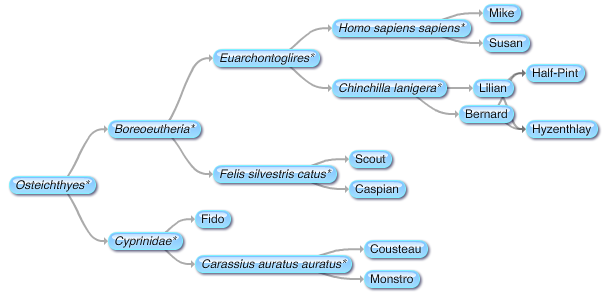
If you look at last year's Yule greeting, you'll note that we have lost a few at the Keesey-Havens household. The mighty Monstro now swims alone in his aquarium, his fellow goldfish Cousteau and his pet minnow Fido having passed away. Young Half-Pint died rather unexpectedly, leaving his chinchilla family in mourning (father Bernard, mother Lillian, sister Hyzenthlay). (I might be posting on him again, though....)

The family tree, as of Yuletide 2010.

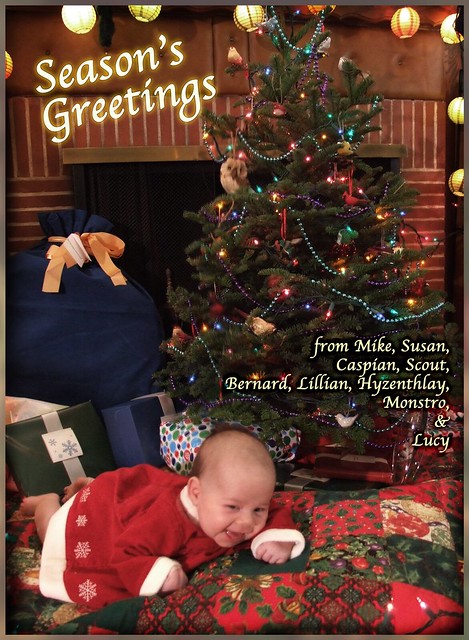
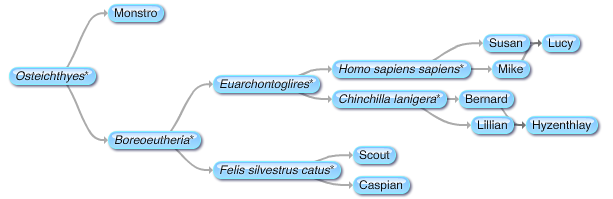
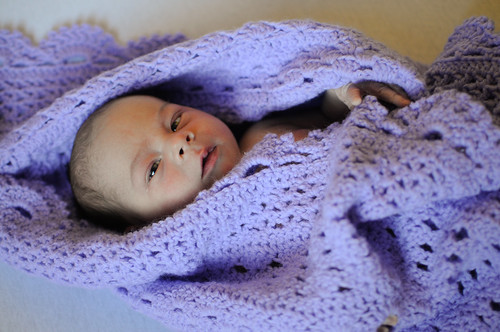
But, in brighter news, we have a new addition! Lucy, the little human pictured above with our Christmas tree. And so it comes time to sadly trim but joyfully decorate our household's phylogenetic tree:

Updated for 2011.


EDIT: Whoops, misspelled "silvestris" in the 2011 version.

16 November 2011

What Is and Is Not a Stem Group

In recent years, I've noticed a trend: the prefix "stem-" is becoming more and more popular for stem groups. For those who don't know what a "stem group" is:

  • A crown group is the last common ancestor or two or more extant taxa, and all descendants thereof.
  • A total group is the first ancestor of a crown group that is not also ancestral to any other extant taxa, and all descendants thereof.
  • A stem group is a total group minus its crown group. (Which means, of course, that a total group is a crown group plus its stem group.)
Or, to put it more simply, an extinct organism is a stem-X if it does not belong to X, but it shares more ancestry with X than with any extant organisms outside of X. Real-life examples:

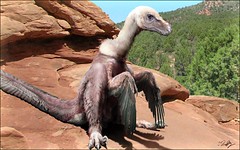
Velociraptor mongoliensis, a stem-avian.
Illustration by myself (Mike Keesey).
  • Stem-mammals: Dimetrodon, Moschops, Cynognathus, Castorocauda.
  • Stem-avians: Marasuchus, Psittacosaurus, Plateosaurus, Tyrannosaurus, Velociraptor, Archaeopteryx, Hesperornis.
  • Stem-humans: Ardipithecus(?), Australopithecus, Paranthropus, Homo habilis, Homo erectus.
  • Stem-cetaceans: Ambulocetus, Pakicetus, Maiacetus, Basilosaurus.
  • Stem-felines: Proailurus, Smilodon.
  • Stem-pterygotes Stem-neopterans: Dictyoneura, Lithomantis.
This is a great convention. It's consistently useful in every area of the Tree of Life. It's concise. It communicates instantly the general area we're talking about, and sets us up to make proper phylogenetic inferences (when the fossil data is lacking).

So I'm glad this trend is becoming more popular. Unfortunately, I've also noticed another trend: rampant misuse!

Case in point:
  • CABREIRA & al. (2011). New stem-sauropodomorph (Dinosauria, Saurischia) from the Triassic of Brazil. Naturwissenschaften (online early). doi:10.1007/s00114-011-0858-0
This looks to be an excellent paper on a very interesting find, so it's unfortunate that there's a glaring error in the title, but there it is: "stem-sauropodomorph". There is no such thing, because Sauropodomorpha is not a crown group. It doesn't even include a crown group (sadly—it'd be very cool if it did). Rather, all sauropodomorphs are part of the avian stem group.

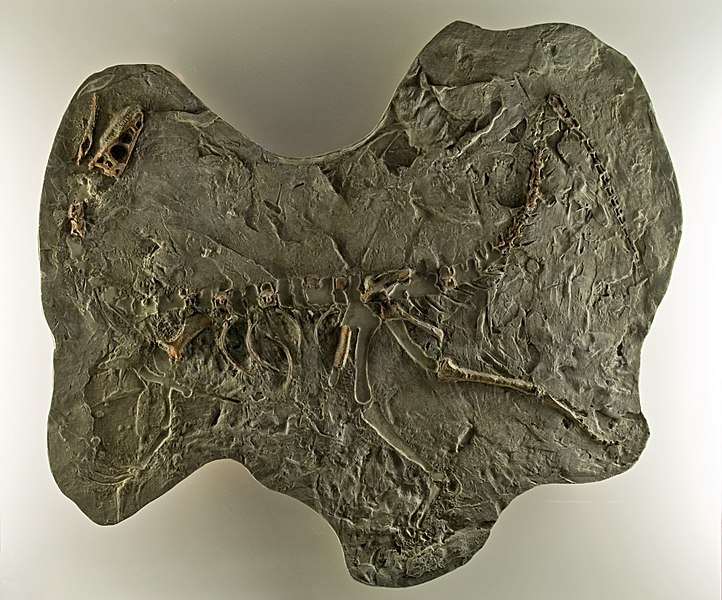
Panphagia protos, a stem-avian
(not a "stem-sauropodomorph").
Photo by Eva K.
Used under the GFDL.
I see a lot of people making this mistake. I think what's happening is that they're using the basic concept of a stem group, but replacing "total group" with "some large clade" and "crown group" with "an interesting subclade". In this case, Sauropodomorpha is "some large clade" and Sauropoda is "an interesting subclade". (And in that case, the usage is even wronger, because it should at least be "stem-sauropod".)

This misuse is unfortunate because it is subjective, while the proper usage is objective. One could make the argument that the real "interesting subclade" of Sauropodomorpha is Titanosauria, or Neosauropoda, or whatever, and then the terminology would mean something very different. By contrast, e.g., "stem-crocodylian" very clearly indicates a particular paraphyletic group.

So, please, people, use the "stem-" prefix, but use it correctly!

04 November 2011

Lucy Gwyn Havens

Last Saturday our first child was born: a daughter, Lucy Gwyn Havens.

Lucy

We've made our own contribution to the phylogenetic tree!


Lucy.—There are many famous Lucys. Here's one relevant to the blog:


And of course, that one is named after this one:

Lucy in the Sky with Diamonds
by Julian Lennon
Gwyn.—Gwyn is an old Welsh family name on my side. More recently it was spelled "Guinn", but we decided to use the older spelling.

Havens.—You'll notice her surname is from her mother, not me. We decided early on that boys would be Keeseys and girls would be Havenses. If this becomes a tradition, it would link patrilineal names to the Y chromosome (something the dominant English system already does) and matrilineal names to the mitochondrial chromosome (a feature sorely lacking in the English system).


We love you, li'l Lulu!

11 October 2011

Human Clades: A Look at a Complex Phylogeny

Most methods of phylogenetic analysis deal with simple trees. In these phylogenies, every taxonomic unit has a single direct ancestor (or "parent"). But we know that phylogeny is often more complex than this. Our own species is an excellent example—while we are all primarily descended from one population in Africa, different peoples around the globe have inherited smaller percentages of ancestry from preexisting populations.

A new study by Reich & al. looks in some detail at peoples who have inherited DNA from the Denisovans, a fossil group known from Siberia. Ancient DNA has been retrieved from these fossils, although unfortunately the fossils are otherwise too scant to tell us much about what Denisovans looked like (other than "humanlike").

Reich & al. posit a complex phylogeny wherein populations are often descended from multiple ancestral populations. Lets take a look at the clades posited in this study.


Operational Taxonomic Units

Reich & al. used the following nine populations, seven extant and two extinct, as operational taxonomic units.


Yoruba.—An ethnicity from West Africa (Nigeria, Benin, Ghana, etc.)
(Photo by Marc Trip.)

Han.—The most populous Chinese ethnicity.
(Photo by Brian Yap.)

Mamanwa.—One of the "Lumad" ("indigenous") ethnicities of the southern Philippines.
(Photo by Richard Parker.)


Jehai.—One of the Orang Asli ("original people") groups of Malaysia.
Note: this photo is of a woman from a different Orang Asli tribe, the Batik.
(Photo by Wazari Wazir.)

Onge.—A group of Andaman Islanders, from the Bay of Bengal.
(Photo from The Andamanese, by George Weber.)

Australians.—The indigenous ("aboriginal") peoples of Australia.
(Photo by Rusty Stewart.)

Papuans.—The indigenous peoples of the New Guinean highlands.
(Photo owned by the Center for International Forestry Research.)
Neandertals.—An extinct group of robust near-human peoples from West Eurasia.
(Photo by myself, of a sculpture by John Gurche.)


Denisovans.—An extinct group of near-human peoples known from Siberia but thought to have had a wider range.
Note: The photo is of a sculpture of Homo heidelbergensis, thought to be the common ancestor of humans, Neandertals, and Denisovans. Denisovans may not have looked exactly like this.
(Photo by myself, of a sculpture by John Gurche.)


Phylogeny


Reich & al. postulated the simplest phylogeny that could possibly explain their data. (Note that the actuality is likely more complex than this, but it's a good starting point.) More recent groups are to the right, and the thickness of the lines indicates the percentage of DNA contributed from population to population.


My diagram, not theirs. Any inaccuracies are my own.
Free for reuse under Public Domain.


I've added a line for the Denisovans' mitochondrial (motherline) ancestor, even though it's not part of the paper's phylogeny. More on that as we start looking through the various clades.


For looking at the clades I'll use a different diagram that does not reflect percentage of ancestry, but simply shows direct descent as unweighted arcs connecting parent and child taxonomic units.


Phylogeny of human and near-human populations according to Reich & al. 2011.
Created using Names on Nodes.
Free for reuse under Public Domain.


15 September 2011

Soft Tissue Characters Supporting the Great Ape Clades

In my last post, I took a look at some morphological cladistic analyses of hominoids (apes) and tried to compile list of characters that supported the major clades: great apes, African great apes, and mangani (chimpanzees + humans). Unfortunately the studies I looked at only considered skeletal characters (and one of them only craniodental characters). Fortunately, a reader (Dartian) suggested some studies that look at soft tissue characters. I've just skimmed this paper:
  • GIBBS, S., COLLARD, M. & WOOD, B. (2002). Soft-tissue anatomy of the extant hominoids: a review and phylogenetic analysis. Journal of Anatomy 200:3–49. doi:10.1046/j.0021-8782.2001.00001.x
The authors compiled a matrix of 171 soft tissue characters and found strong support for the topology produced by earlier molecular studies (gibbons, (orangutans, (gorillas, (humans, chimpanzees)))). Below, I've compiled lists of character states that unambiguously support the major clades:

31 August 2011

Characters that Support the Great Ape Clades

Anyone familiar with the current state of great ape phylogeny knows that the following structure is well-supported:
  • Great apes are a clade.
    • Orangutans are a subclade of great apes.
    • African great apes are a subclade of great apes.
      • Gorillas are a subclade of African great apes.
      • Mangani are a subclade of African great apes.
        • Humans are a subclade of mangani.
        • Chimpanzees are a subclade of mangani.
And most such people probably know that the primary evidence for this structure is molecular. But there has to be morphological data to back this up, right?

Great Apes
I've been trying to hunt down such morphological data, but it's been a bit hard. There really aren't that many morphology-based cladistic studies of primates, and the few that exist either exclude humans or focus on stem-humans more than living great apes.

An example of a study that looks at a wide array of fossil and living primates, but fails to include humans:
  • Rossie & Seiffert (2006). Continental paleobiogeography as phylogenetic evidence. Pages 469–522 in Lehman & Fleagle (eds.) Primate Biogeography: Progress and Prospects. Springer, New York. 546pp. isbn:0387298711
An example of a study that includes some living great apes, but focuses on stem-humans:
  • Strait & al. (1997). A reappraisal of early hominid phylogeny. Journal of Human Evolution 32(1):17–82. pmid:9034954
I've compiled some shared character lists from these:

30 August 2011

Guest Post: Similarities Between Macaque and Human Brains

Despite the title of this blog, I've rarely if ever actually discussed simian brains. (The title refers to my own brain, or more generally the brain of any human that's ever thought about their place in the universe.) Reader Allison Gamble has kindly volunteered to rectify this situation with A Three-Pound Monkey Brain's first-ever guest post. Enjoy!


Similarities Between Macaque and Human Brains

by Allison Gamble
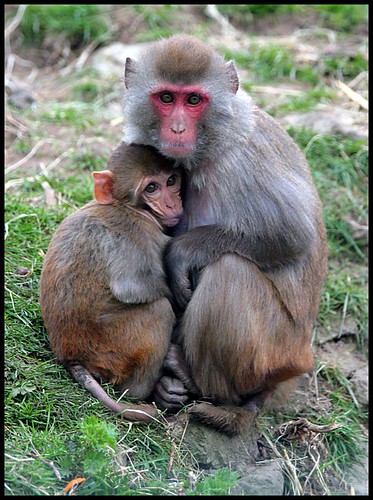

Rhesus Monkeys
Rhesus macaque
mother and child
by David Lewis
Evolutionary scientists believe that humans and Old World monkeys, such macaques, evolved from a common ancestor. At some point in the past our paths diverged. As different as we may look on the outside, humans and macaques share many common behavioral traits, all of which have a basis hidden deep within our brains.


Rhesus macaques and other Old World monkeys are often used in scientific and medical experimentation. They make ideal research subjects because in many ways, human brains and Old World monkey brains are very similar. The more we learn about the similarities and differences between human and Old World monkey brains, the better the picture we can get of the two groups’ evolutionary paths since diverging from that common ancestor about 30 million years ago. What's more, these Rhesus macaques’ brains may hold keys to understanding the neurological and cognitive bases of prejudice, racial discrimination, and associated violent behaviors that could be massive boons to forensic psychology and other disciplines we humans use to better understand ourselves.


Size Matters
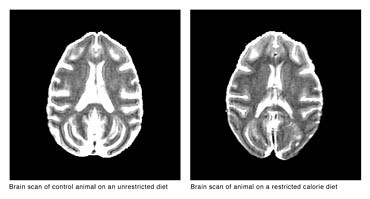
monkey_diet_brain_scans09
Scans of Rhesus macaque brains
by Ellery Chen
What is the primary difference between Old World monkey brains and human brains? Size and shape are the most obvious. The average adult human brain weighs between 1,300 and 1,400 grams, and even an average newborn human baby's brain is about 350 to 400 grams. An average Rhesus macaque's brain is approximately 90 to 97 grams. Humans have the largest brain-to-body ratio of any primate.


A Single Gene Makes a Huge Difference
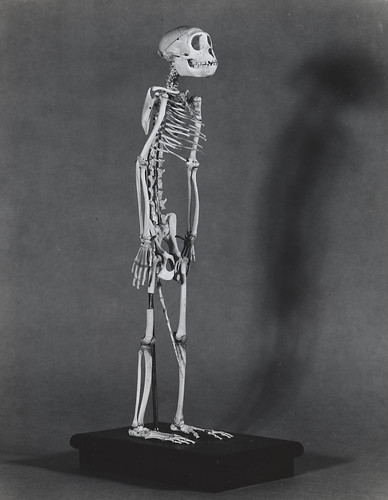
Able
Skeleton of 'Able',
a Rhesus macaque sent into space.
From the Otis Historical Archives,
National Museum of
Health & Medicine.
According to a recent study conducted at Emory University, Rhesus macaques demonstrated a trait previously thought to belong solely to humans: recalling past images and applying them to a current situation. Why is this important? The ability to learn from past actions is the basis for imagination and planning for the future, the key to complex societies and survivability of the species. A Yale University study found the primary difference between Old World monkey brains and human brains may be the activation of a single gene, NDE1, which controls the growth of the cerebral cortex.


The cerebral cortex covers both hemispheres of the brain. While parts of it control basic physiological functions like sensory input and limb or eye movement, other areas are responsible for advanced functions like memory, abstract thinking, language, creativity, emotion, judgment and attention. While initially it may seem like these are solely human abilities, studies and research have shown that this idea is false.


Macaques Have Self-Doubt


As an example, one study found that macaques have the capacity to doubt themselves in a manner similar to humans. The professors conducting the study, Michael Beran from Georgia State University and John David Smith from State University of New York, trained macaques to play a computer game that asked the macaques questions. The macaques were given a treat when they answered the questions correctly. Over time, the macaques learned to avoid the difficult questions. When they were unsure of their answer, they could pass on the question. New World monkeys were also tested, but did not show the same awareness of their own thought. Since New World monkeys are not as similar to us as Old World monkeys this was to be expected. The significance of the study, according to Dr. Smith, is that self-awareness is a crucial part of human development, and the presence of it in Old World monkeys could help provide a sense of how it evolved.


Macaques Have Mirror Neurons


Both humans and macaques have what are known as 'mirror neurons.' These brain cells fire when we observe someone else performing the same action as us. What is the significance of mirror neurons? They're crucial to the capacity for behaviors such as empathy, emotional contagion (for example, when others laugh and you can't help but start laughing as well), and even developmental disorders like autism.


Instincts in Humans
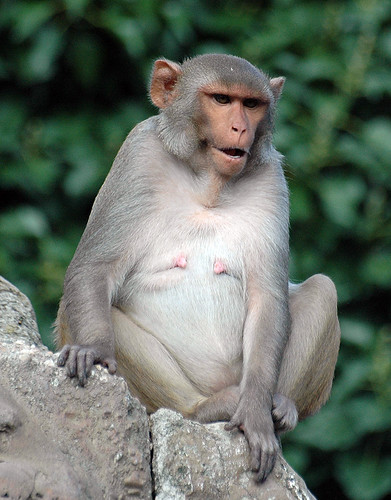
Rhesus macaque
Rhesus macaque
by Vincent van Dam
Some scientists don't like to use the word 'instincts' in association with humans. They prefer terms like 'natural predisposition.' While this may simply be a semantic difference, it is the cause of much controversy and debate in scientific circles.


Do humans have an instinct for violence? If so, where did that instinct come from? The answer isn't simple, as the nature vs. nurture debate has been raging for ages. One study indicated that Rhesus macaques recognize other Rhesus macaques as either belonging to the group or as outsiders. They also appeared to associate the outsiders with things that were frightening or dangerous, leading the researcher to conclude that the macaques had instincts for prejudice and even racism. By extension, humans may also have a disposition towards racism and prejudice, two behaviors that have certainly inspired a fair share of violence over the years.


By continuing to study our Old World cousins, we can discover much about our own behavior, including how we learn, how we view others and, how we view ourselves. However, despite the striking similarities between human and Old World monkey cognition and behavior, a crucial difference in humans remains that once we are aware of how we behave, we can self-correct. In this way we separate ourselves from the monkeys, and perhaps it is this ability that more than anything else defines our humanity.