27 May 2011

Silence

So I was busily and excitedly writing about my new site, PhyloPic, back in February and early March, and then this blog went silent. What happened?


Something terrible.


My father, Timothy Alan Keesey, passed away on March 10th. He had gone into the hospital the previous day. He didn't last the night.


Dad was known as a "gentle giant"a towering, athletic man of great patience. He was a pleasant man, very well-liked.


He instilled an appreciation of nature in his children, my sister and me. Our most common family pastime was hiking. We frequented the Billy Goat Trail, between the Potomac River and the C&O Canal, where he showed me how to catch reptiles, and how to tell a broad-headed skink from a five-lined skink. He'd been a biology major, and I owe my interest in biology in large part to him (by both genetic and memetic transmission).


I also owe my interest in programming to him. Not that he was a programmer (apart from taking one course back in the punch-card days), but he bought the family a TI-99/4A back during a time when it was pretty rare to have a home computer. We never got any software for it, so the only way to use it was to learn BASIC. I became pretty much the sole user, teaching myself how to program from the BASIC manual. No other single act has contributed so much to my ultimate career.


Dad's obituary is here. It doesn't tell much about him as a person—his quiet demeanor, his keen intellect, his skill with cars, sports, and animals.


Goodbye, Dad, and thanks.


But this year has not been entirely without good news.


I'm comforted by the fact that, before he passed away, Dad knew he'd be getting another grandchild. (My sister already has a daughter.) My wife, Susan, is expecting our first child.


My dad was a wonderful father. I have both a good model to follow and a high standard to live up to.


By strange coincidence, our daughter's due date is October 14th—Dad's birthday.

08 March 2011

To Flash or not to Flash

I love building stuff with Flash technologies. I think ActionScript 3.0 is an excellent language and Flex 4 is a very good framework. I'm not particularly enamored of the alternatives. I find JavaScript to be a mediocre language (albeit with some excellent libraries). I don't like wrangling CSS more than I have to (although Less makes it much nicer). I find HTML 5 to be a pretty immature technology so far. SilverLight's days are probably numbered. (I haven't yet delved into mobile operating systems, like Android and iOS, so I can't speak for those. And those aren't complete alternatives, anyway.)


Because I love Flash, I have a tendency to want to build everything in it. But over the years I've learned that this tendency must be curbed whenever possible. There are definite downsides to Flash, and especially to doing entire websites in Flash. (The now-defunct March of Man website and some abandoned versions of the Dinosauricon are testaments to this.)


For PhyloPic, it was pretty clear to me that there would be no significant advantage to building it in Flash. Load times would be increased without any functionality enhancement. I wouldn't be able to use it on my iPhone. And all the functionality I needed was easily available in plain old HTML/JavaScript/CSS.


With one exception.


The Submission Tool is built as a Flex app. There is one primary reason for this: image processing. Processing the silhouettes on the server side was an option, but one that could have potentially bogged the server down. (It's already starting to buckle a bit as is, pending some optimizations.) But, by using Flash's BitmapData class, I can do that bit of work on the client side before the silhouettes are shipped off to the database.


Of course there are some other benefits as well. In descending order of importance:

  • Flash allows for a more unified experience for the submitter. No page reloads and no cross-browser differences.
  • SPAM bots are much more capable of cracking HTML forms than cracking custom AMF web services. SWF files are generally opaque to them.
  • It was easier for me to build and test.
Had it just been those three reasons, there might still have been a good argument to do it as HTML/AJAX. The image processing requirement is what really tipped the scales. One hundred submitters contrasting, cropping, and rescaling bitmaps is much nicer if they're doing it on their own machines than if they're all doing it on the server. (Okay, I've barely had even two simultaneous submitters so far, but I can dream....)

There may be other Flash tools in PhyloPic's future. For example, I think it is the best technology for the Cladogram Generator. But for the rest of the site, plain old HTML/JavaScript/CSS is certainly sufficient—better, even.

UPDATE (2012 Jan 26): The Submission Page still uses Flash but is not a Flex app.

05 March 2011

PhyloPic Week 2: Lineages, Browsing, and API

Another good week for PhyloPic. There are now well over 200 silhouettes in the database. I also rolled out some new features and enhancements.

Redesigned Lineage Pages

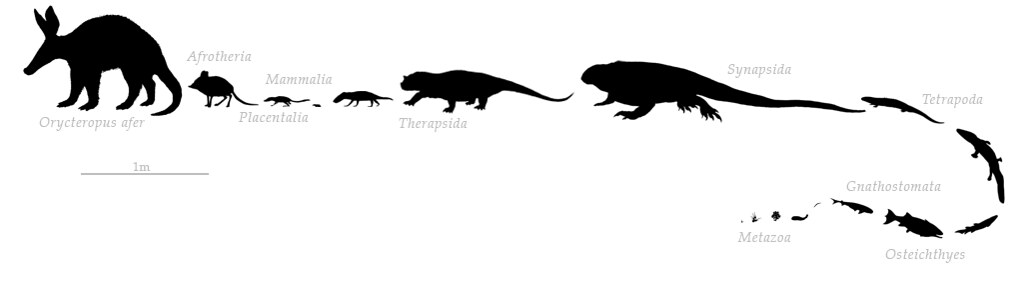
Lineage pages now provide taxonomic and license information for each image. As a visual touch, figures now fade as they go deeper and deeper into the past. Here's a few of my favorite lineage pages so far:
Yes, they're all bilaterian animals. There's a definite bias.

Image Browser

Now you can peruse the entire gallery much more easily, with the Image Browser. Use the arrow(s) on the side to navigate through pages of silhouettes.


Developer API

For any developers out there who want to use the PhyloPic database to create their own apps, now you can. I've provided an initial API, available both as a JSON service and an AMF service for Flex apps.

Also of news to developers: I've opened up the code base for viewing and cloning. (Still need to add the licenses, though.) It's a Django app, written in Python. Feel free to poke around.

Thanks


I'd like to thank everyone who's submitted images so far, especially FunkMonk, Scott Hartman, Matt Martyniuk and Maija Karala for their many contributions. (Each of them has submitted at least a dozen.) Thanks also to Steven Coombs, Craig Dylke, Mo Hassan, Neil Kelley, Dann Pigdon, Ville-Veikko Sinkkonen, Patrick Strutzenberger, Reka Szabo, David Tana, Michael P. Taylor, and Emily Willoughby!

28 February 2011

The First Week of PhyloPic

I announced PhyloPic last week and the response has been great. I launched with ~95 images and we are already up to 170! (Possibly more by the time you read this.) Some of the lineages are becoming pretty complete. Some of the better ones:
For the last one, I made a special collage:

Evolution of the Human

(Click on it and check out the Flickr page to find an extremely high-resolution version.)

Of course, other areas of the Tree of Life are not quite so fleshed out. For example, if you look up a plant you'll usually get this. (Or even less if you didn't happen to pick a tracheophyte.) So there is plenty of illustrating left to do.

There is also plenty of programming left to do. You can see a list of major remaining tasks on PhyloPic's BitBucket page. Here are a few, with links to their pages:
If any of these interest you, I encourage you to vote for them by clicking the "Bump!" button:

And if you have any ideas, you can also suggest features.

At least one blog has created its own PhyloPic feature. Traumador at Art Evolved put together an excellent tutorial on creating silhouettes using Photoshop. (They also posted about PhyloPic here.) Blogger David Tana of Superoceras also awarded PhyloPic his Interweb Science of the Week award.

In summary, the project's going very well and I'm pretty excited about it. I can't wait to see what the rest of the year holds for PhyloPic!

21 February 2011

Introducing PhyloPic: An Open Database of Reusable Silhouettes

Ever had this problem? "Boy, I could sure use a silhouette of [some kind of organism] for this diagram I'm working on. But I can't find anything on the web! Well, except for a few images which are copyrighted...."

What if there were a website with an open database of reusable images, available under Creative Commons licenses? What if you could do phylogenetic searches, so that, even if there weren't a silhouette for the taxon in question, you could at least find something close? What if you could build images like this...


...without having to look all over the web for figures?

Well, now you can! I've launched a new site called:


It's currently in public alpha, which means it's not quite done. So, I have some caveats:

  • I'm pulling most taxonomic data from uBio. It's great because it's really comprehensive. But it's also a huge mess because it stores multiple classifications, many of which are outdated and disagree with each other. (This isn't uBio's fault, as its goal is to store all these classifications, not to offer one nice, neat classification.) So you may (will) find some errata in the phylogenetic system. I'm working on cleaning it up, but there are a lot of taxonomic names out there....
  • It's still early on, so there are only about a hundred images in the database. It will grow over time, but don't be surprised if the closest image it has for your favorite invertebrate is some kind of indiscriminate worm.
  • There are some known bugs (and I don't mean Hemiptera). The Issues Page is open to all, though, so you can read the known issues and report new ones. (Please do!)
It's a work in progress, but I think it has enormous potential. And I think it's reached a state where it's ready for public use and feedback. So have a look, see what you think, and let me know! (And, if you're artistically inclined, please consider submitting some silhouettes of your own.)

04 January 2011

Hybridizing Stem-Humans: Or, Is Everyone Right?

Analysis of mitochondrial DNA shows that the human matrilineage split from the Denisovan matrilineage around a million years ago. The nuclear genome shows a more recent split of humans (Homo sapiens) from both Denisovans (Homo sp. indet.) and Neandertals (Homo neanderthalensis) around 270–440 millennia ago. And yet some modern humans (Melanesians) appear to have inherited a small portion (4–6%) of nuclear DNA from Denisovans. This means that hominin populations can recombine even after being split for hundreds of thousands of years.


A "wholphin" (Tursiops truncatus × Pseudorca crassidens).
Photo by Mark Interrante.
 
Properly considered, this is not shocking at all. In other placental species, populations that have been split for far longer periods of time can hybridize. Look at "wholphins", hybrids between bottlenose dolphins (Tursiops truncatus) and false killer whales (Pseudorca crassidens). Those parent species have been split for around seven million years, longer even than the split between humans and chimpanzees!


Of course, humans can't (or at least don't) interbreed with chimpanzees, so the length of the split is not a perfect predictor of whether lineages can recombine. But it's interesting to consider how much lineage recombination might have occurred in stem-humans. The most divergent known lineages from our own are probably late Paranthropus (P. robustus and P. boisei). Our common ancestor with them is generally thought to be something like Australopithecus africanus, or perhaps Praeanthropus afarensis. Even opting for the older choice, this would make the length of their split from our putative contemporaneous ancestor, Homo habilis, only around a million years (roughly). That's not a terribly long split.


Did Homo habilis have multiple ancestors?
(Photo by Charles Roffey)
What this says to me is that there is no a priori reason to suppose that any two contemporary populations of hominin could not have interbred. Maybe Paranthropus aethiopicus interbred with early Homocould this explain Australopithecus garhi? Maybe the Denisovans themselves are Homo erectus × neanderthalensis. Maybe Homo floresiensis are pinheaded, pygmy descendants of Homo erectus and an unknown, pre-Homo lineage! (I'm not saying I necessarily support any of these ideas; I'm just throwing them out there.)


Also consider the debates over human ancestry in the field of paleoanthropology. It's a common observation that whenever someone finds a new stem-human (or stem-mangani) species, they declare it a human ancestor, while their rival colleagues pooh-pooh the finding and maintain that their own specimens are the true ancestors. (There are notable exceptions to this, of course, but it does seem to happen again and again.) But what if everyone is right? What if most of these fossil species are ancestral to us, but in varying proportions? I can't see any reason why this would be unimaginable.


A human with partial
Neandertal ancestry
(blog's author).
Again, this is not an uncommon phenomenon in other placental species. Consider coyotes (Canis latrans)the eastern populations have partial ancestry from wolves (Canis lupus). Eastern lowland gorillas (Gorilla beringei graueri) may have partial ancestry from western gorillas (Gorilla gorilla). Our species is not unique in being partially hybridized.


So when people argue whether we are descended from Praeanthropus afarensis vs. Australopithecus africanus vs. Orrorin tugenensis vs. Kenyanthropus platyops—maybe everyone is right! At the very least, it seems to me that future discovery depends on allowing for significant amounts of admixture, and not blindly assuming simple bifurcation.


References

  • Ackermann & Bishop (2009). Morphological and molecular evidence reveals recent hybridization between gorilla taxa. Evolution 64(1):271–290. doi:10.1111/j.1558-5646.2009.00858.x
  • Green & al. (2010). A draft sequence of the Neandertal genome. Science 328:710722. doi:10.1126/science.1188021
  • Kays & al. (2009). Rapid adaptive evolution of northeastern coyotes via hybridization with wolves. Biol. Lett. 6:89–93. doi:10.1098/rsbl.2009.0575
  • Kim & al. (2009). Evolutionary charactterization of a highly repetitive sequence identified from the false killer whale (Pseudorca crassidens). Genes Genet. Sys. 84:185–189. doi:10.1266/ggs.84.18
  • Reich & al. (2010). Genetic history of an archaic hominin group from Denisova Cave in Siberia. Nature  468:1053–1060 doi:10.1038/nature09710
  • Xiong & al. (2009). Seven new dolphin mitochondrial genomes and a time-calibrated phylogeny of whales. BMC Evol. Biol. 9. doi:10.1186/1471-2148-9-20

23 December 2010

What is a human?

Find the human! Pretty easy, right? RIGHT??
It is obvious what is "human" and what is not if we just look at living organisms. There's a clear gap between us and our closest living relatives, the chimpanzees. No danger of mistaking one for the other.

But this clarity vanishes as soon as we look at the fossil record. There's a gradient of forms between us and things that are not clearly closer to us or chimpanzees (ArdipithecusOrrorinSahelanthropus). Which ones are "human" and which are not? Is Praeanthropus afarensis human? What about Homo habilis? Homo ergaster? Neandertals? Homo sapiens idaltu?
Find the human! Or is there more than one?
Or are they all human?


This issue crops up for all kinds of taxa. Much time has been spent arguing what is and is not e.g., avian, or mammalian. The issue is more common within vertebrates than many other taxa, since vertebrates have an especially good and well-studied fossil record. But it applies, in theory or practice, to every extant taxon.


I subscribe to the school of thought that names born from neontology (the study of extant organisms) are best restricted to the crown group (that is, to the living forms, their final common ancestor, and all descendants of that ancestor). Arguments for restricting common names to crown groups were first laid out by de Queiroz and Gauthier (1992). The primary reason for doing this is that it prevents unjustified inferences about stem groups (that is, the extinct taxa which are not part of the crown group, but are closer to it than to anything else extant). For example, we currently have no way of knowing whether the statement, "Within all mammalian species, mothers produce milk," is true if we include things like Docodon as mammals (or, as a few have done, even earlier things like Dimetrodon). However, if we restrict Mammalia to the last common ancestor of monotremes and therians (marsupials and placentals) and all descendants of that ancestor, then the statement unambiguously holds.


This system also gives us a very easy way to refer to any stem group: just add the prefix "stem-". Some examples:
  • stem-avians: Pterodactylus, Iguanodon, Diplodocus, Eoraptor, Coelophysis, Tyrannosaurus, Oviraptor, Velociraptor, ArchaeopteryxIchthyornis
  • stem-mammals: Casea, Dimetrodon, Moschops, Cynognathus, Docodon
  • stem-whales: Indohyus, Ambulocetus, Pakicetus, Basilosaurus, Dorudon
  • stem-humans: Ardipithecus(?), Praeanthropus, Australopithecus, Homo habilis, Homo ergaster
stem-humans
This is a nice, neat system. However, for humans, it gets a little sloppy the closer we get to the crown group.

For a long time, there was a debate in paleoanthropology as to how our species originated. We are distributed across the globe, so it's not immediately obvious where we are from. As the hominin fossil record gradually came to light during the 20th century, it became clearer that the earliest roots of the human total group were in Africa, since that's where the oldest remains are found. Everything before two million years ago is African, and only after that time period do we start to see remains in Eurasia, all of them belonging to the genus Homo. Remains in Australia and America don't occur until very late, and only modern humans appear in those regions.

But this leaves open the question of our own species' origin. Homo had spread all over the Old World by the time modern humans appeared, so we could have come from anywhere in Africa or Eurasia. Two major hypotheses were formed. The Out of Africa Hypothesis suggested that the ancestors of humans originated in Africa and then spread out over the globe, displacing all other populations of Homo: the Neandertals in West Eurasia, Peking Man in Asia, Java Man in Malaya, etc. The Multiregional Hypothesis, on the other hand, suggested that modern human races evolved more or less in their current areas: Negroids were descended from Rhodesian Man, Caucasoids from Neandertal Man, and Mongoloids from Peking Man.

These hypotheses competed with each other until the advent of genetic analysis. When scientists were finally able to study the mitochondrial genome, which is copied from mother to child, they found that all living humans shared a relatively recent matrilineal ancestor, much more recent than the splits between Rhodesian, Neandertal, and Peking fossils. Furthermore, the matrilineal family tree strongly points to an ancestor in Africa, where the most divergence is found. Study of the Y chromosome, which is copied from father to son, indicated an even more recent patrilineal ancestor, also African. The case seemed closed. Out of Africa had won.

The case seemed further bolstered when the Neandertal mitochondrial genome was recovered. It revealed a signature which clearly placed it outside the modern human group (Teschler-Nicola & al. 2006). Earlier this year, mitochondrial DNA was also retrieved from an indeterminate fossil from Denisova, Siberia, indicating that it represented a matrilineage even further out, preceding the human-Neandertal split (Krause & al. 2010).

This would give us a pretty nice, clean series of splits. And it would mean that Neandertals, Denisovans, etc. are stem-humans.

But there is more to ancestry than just the matrilineage and the patrilineage. Most of our ancestral lineages include members of both sexes (think of your mother's father and your father's mother). The matrilineage and patrilineage are the only ones that can be studied with clarity, since all other chromosomes undergo a shuffling process. But those other lineages exist nonetheless.

Only very recently has evidence come to light which challenges Out of Africa, at least in its strong form. Earlier this year, a study suggested that all humans except for Sub-Saharan Africans have inherited 1–4% of their DNA from Neandertal ancestors (Green & al. 2010). And just yesterday, a new analysis of Denisovan nuclear DNA showed that Melanesians have inherited 46% of their DNA from Denisovans. This nuclear DNA seems to originate from an ancestor close to the human-Neandertal split, but somewhat on the Neandertal side.

Long story short, the picture has gotten a lot more complicated. It's no longer, "Out of Africa, yes, Multiregional, no." Now it's, "Out of Africa, mostly; Multiregional, somewhat."

So what does this mean for the term "human"? Are Neandertals and Denisovans human? After all, they seem to be ancestral to some, but not all, modern human populations.

Well, they can only belong to the crown clade if they are the final common ancestor of all living humans, or descended from it. Neither of these criteria appear to hold. So, for now, I would still say that they are not human, only very close to human. (Note that this does not mean that people descended, in part, from Neandertals and/or Denisovans are somehow "less human" than those with pure African ancestry. The African ancestors are also not humans but stem-humans under this usage. This usage is discrete; you're either human or you aren't.)

Still, at this level of resolution, we start to see a problem with the crown clade usage. What is the final common ancestor? Many would assume it to be the last-occurring common ancestor, but this is problematic, and not just because that ancestor probably lived within recorded history (making, e.g., the Sumerians inhuman!). When I say "final" I'm really referring to something a bit more complexthe maximal members of a predecessor union. (More discussion here.) But determining what that is, exactly, requires better datasets than we have.

I still think it's a good convention, and if its application is a bit vague, so be itour knowledge is a bit vague. For now I would say that humans are a clade of large, gracile hominins with high-vaulted crania that emerged roughly 150,000 years ago in Africa, and then spread out. They are descended from not one but at least three major populations of stem-human. One of these, the African population (idaltu, helmei, etc.), forms the majority of the ancestry, up to 100% in some populations. The others, Neandertals and Denisovans, only form a small part of the ancestry of some humans.

I feel this convention is useful because it prevent unjustified inferences. For example, we know that all living human populations have languages with highly complex grammar. We really don't know whether Neandertals and Denisovans had such languages, or whether the immediate African predecessors of humans did, for that matter. So it's good to be able to categorize them as stem-humans, because it reminds us that we don't have as much data available on them as we do for the crown group. We have to be more clever in figuring these things out.

And if we ever cloned a Neandertal? Well, ask me again once that happens.

References
  • de Queiroz & Gauthier (1992). Phylogenetic taxonomy. Annual Review of Ecology and Systematics 23:449480. [PDF]
  • Green & al. (2010). A draft sequence of the Neandertal genome. Science 328:710722. doi:10.1126/science.1188021
  • Krause & al. (2010). The complete mitochondrial DNA genome of an unknown hominin from southern Siberia. Nature 464(7290):894–897. doi:10.1038/nature08976
  • Reich & al. (2010). Genetic history of an archaic hominin group from Denisova Cave in Siberia. Nature 468:1053–1060 doi:10.1038/nature09710
  • Teschler-Nicola & al. (2006). No evidence of Neandertal mtDNA contribution to early modern humans. Pages 491503 iEarly Modern Humans at the Moravian Gate. Springer Vienna.  doi:10.1007/978-3-211-49294-9_17