Showing posts with label illustration. Show all posts

04 March 2014

Deeper Dive on the PhyloPic T-shirt

Just to review:
  •  PhyloPic is a website featuring freely-reusable silhouettes of organisms. Anybody may submit images under a Creative Commons license.
  • I am attempting to raise funds to host PhyloPic for the next two years by selling a PhyloPic T-shirt, depicting the past half-billion years of our evolutionary lineage with free silhouettes.
We've come a long way.
In this post I'll go into more detail about what, exactly, is on the shirt, starting with the final silhouette and going back in time. In each entry, the taxonomic name links to a page for the image, with artist and license information. Some terminology first: "concestor" means "most recent shared ancestor", and "stem-X" means "not X, but more closely related to X than to anything else alive".


The final silhouette is a modern human, Homo sapiens sapiens, specifically a Melanesian woman. Melanesians and other Oceanians represent one of the furthest migrations of humanity from our original geographical range.

Immediately behind her is another Homo sapiens sapiens, this one a Subsaharan African man. Subsaharan Africa is the wellspring of modern humanity. (This isn't meant to imply an ancestordescendant relationship between the two figures; they're just coexisting members of the same subspecies.)

24 February 2014

Half a Billion Years in the Making: The PhyloPic T-shirt

Yes, now you can wear PhyloPic.

The PhyloPic T-shirt
PhyloPic's silhouettes are free, but hosting the site costs money. With this shirt, I'm trying to raise enough to cover basic expenses. If 100 of you buy a shirt, you will cover PhyloPic's hosting for the next two years.

The design uses PhyloPic silhouettes to depict the evolutionary lineage of humanity, starting with the earliest bilaterian animals. All of the silhouettes are public domain, or available under a Creative Commons Attribution or Attibution-ShareAlike license (which means the design itself is under a Creative Commons Attibution-ShareAlike license). The works of ten artists are featured:

The shirt is only available through March 15. As of this morning, 25 shirts have been purchased, meaning that we are exactly one quarter of the way to the goal. So help PhyloPic out, and get a great T-shirt! Or, if you can't*, at least help spread the word.

Do you have PhyloPic's back?

* Apologies, but shipping is only available in the U.S., Canada, and Army or Fleet Post Offices. But if this campaign does well, I'll certainly look into a more global option for future shirts. (Yes, plural. Why should Homo sapiens get all the fun? PhyloPic has good coverage of many other lineages.)

11 May 2013

PhyloPic Passes a Thousand Images!

Just a little while ago, PhyloPic reached its first 1000 silhouettes! Here's the thousandth, the eusauropod dinosaur Cetiosaurus oxoniensis, by Michael P. Taylor:

(Public Domain)
Several contributors seem to have all been vying for the spot. Around the same time we got some other lovely contributions. Gareth Monger contributed this upside-down butterfly, Aglais urticae:

(Creative Commons Attribution-ShareAlike 3.0 Unported)

He missed the 1000th spot and got 1002nd. Matt Martyniuk missed it on the opposite side, with this Lambeosaurus (hadrosaurid dinosaur) at 993rd:

(Creative Commons Attribution-NonCommercial-ShareAlike 3.0 Unported)
Emily Willoughby got quite close, too, and intended this rather recognizable angiosperm leaf (Cannabis sativa) for the 1000th spot. Alas, it's 1007th:
(Creative Commons Attribution-ShareAlike 3.0 Unported)
(As she noted, 420 would have been a good number as well.)

Thanks to everyone who contributed to the first thousand silhouettes! It took two years to get here  may the next thousand be even faster!


02 April 2013

Why the PhyloPic Relaunch Took So Long

Or, A Lesson in Development Strategy.

As I announced last week, my website, PhyloPic, has been relaunched with a massive update. One of the key updates is a public API for developers. A lot of people have been looking forward to this, and it was actually almost ready for release last summer. So why didn't I release it?

Failure to Branch

Basal tracheophyte.
Public Domain.
As I was writing up the documentation for the API, I learned of Bootstrap, a CSS/JavaScript framework. I realized that it could solve a lot of the design issues I was having — problems with the site on mobile devices, older browsers, etc.

What I should have done: Created a new development branch for adding Bootstrap while continuing to polish up the API branch. That way, I could have released the API shortly while still being able to work on the design issues in parallel.

What I actually did: Continued working in the same branch, ensuring that I couldn't release the API update until the Bootstrap update was complete.

Having Other Projects

By the end of summer I was mostly done with the revisions, but there was still some cleanup to do. By now some other projects I'm attached to, one with other collaborators, were suffering. So I spent most of my free time in the autumn working on those. (I have a full-time job and a toddler, so that isn't much.)

Homo habilis.
Public Domain.

Becoming Enamored of New Technology

In the autumn, Microsoft release a preview version of TypeScript, and I quickly saw that it was going to be extremely useful. So I rewrote PhyloPic's client-side code — it wasn't too hard and it made further development a lot easier. This caused some delay up-front, but I don't regret it.

Becoming Enamored of the Wrong New Technology

Around this time I also realized that I could finally do away with the last bit of Flash on the website: the Image Submission Tool. HTML5 had become mature enough to do all the image manipulation in the browser itself. I did a lot of research, learning about the Canvas, Typed Arrays, etc. And after a lot of work I actually created an image-processing workflow that work in HTML5-enabled browsers. As a bonus, I got a little standalone project out of it: Pictish.

But there were problems. One is that the best existing JavaScript library for creating PNG files doesn't use Typed Arrays — it uses strings, which means that it is slow for large files. I tried creating my own PNG encoder, or adapting that one, but soon realized it was far too much work. Another problem is that I was no longer supporting older browsers (although this was a trade-off against supporting mobile platforms, so I didn't feel too bad about it).

But there was a much more fundamental danger: doing the image-processing in the client side meant that the API had to trust the client to do it properly. What if some developer used the PhyloPic API to add images to the database but didn't do it right? That could be disastrous.

Octopus bimaculatus.
Public Domain.
I realized I would have to do things the old-fashioned way: on the server. After a bit of research, I identified Image Magick and Inkscape as the best tools. The new methodology was so completely different that I ended up making a lot of database changes, too. Until recently, all files were stored in the database — now they're just stored as flat files. The good news is that this makes load times faster.

Doing Things the "Right" Way

Throughout all this I had been making an effort to "dogfood" my own API, i.e., to use it on the site itself. This has the advantage of making load times faster, since the basic page can be cached and then the data can be loaded in secondarily in a much smaller format. Unfortunately this meant a lot of rewrites for how the pages are rendered.

After a while, the code to generate pages from the data had gotten really complex (mostly involving on-the-fly element generation using jQuery). Around the time I was redoing the Image Submission Page, I realized my whole approach was untenable. I needed a cleaner way to divorce presentation logic from control logic.

I ended up using Knockout for the entire site. It made things a lot more manageable.

In Summary

The biggest problem was my branching model, or, rather, my lack of one. Solitary developers often fall into this trap: we think that, since we're doing all the work, there's no need to have more than a single branch of development. At work, we've been using this model and found it very successful. Going forward, I plan to do this on PhyloPic as well. No more massive updates where everything is different. Just incremental features and fixes.

31 March 2013

PhyloPic Launch: API, Responsive Design, etc.

On Good Friday I took PhyloPic down. On Holy Saturday, I wrestled with errors caused by incongruities between the server and dev environments. And, lo, now, on Easter Sunday I announce that PhyloPic is back! (Actually, I already announced in on Twitter, but whatever.)

How smartphone users should see PhyloPic, more or less.

Major New Features:


  • A Developer API (using JSON). Now other people can build applications using PhyloPic data and images. (Yes, I am dogfooding it, so most of it should be pretty well-tested.)
  • Responsive design (using the ever-more-ubiquitous Bootstrap the site is now much more useable on mobile devices.
  • A Links Page, showing off work that uses PhyloPic or features it in some way.
  • Speedier load times (in theory, anyway).
  • Ranks for Contributors — if you submit one image, you're a "Specialist". Two, and you're a "General". Six, and you're a "Familiar". See where this is going?
  • Fewer requirements — most notably, Flash is no longer required to submit images.
  • Handy little icons on most taxon links — now you can tell if you're clicking on Gastonia the dicotyledonous plant or Gastonia the dinosaur. (Still rolling this out to all taxa.)

19 March 2013

Preview Screenshots

A little glimpse of what I've been working on:


10 March 2013

"Year of Macrauchenia": Third and Final "All Your Yesterdays" Entry

I made a last-minute entry for the All Your Yesterdays contest:


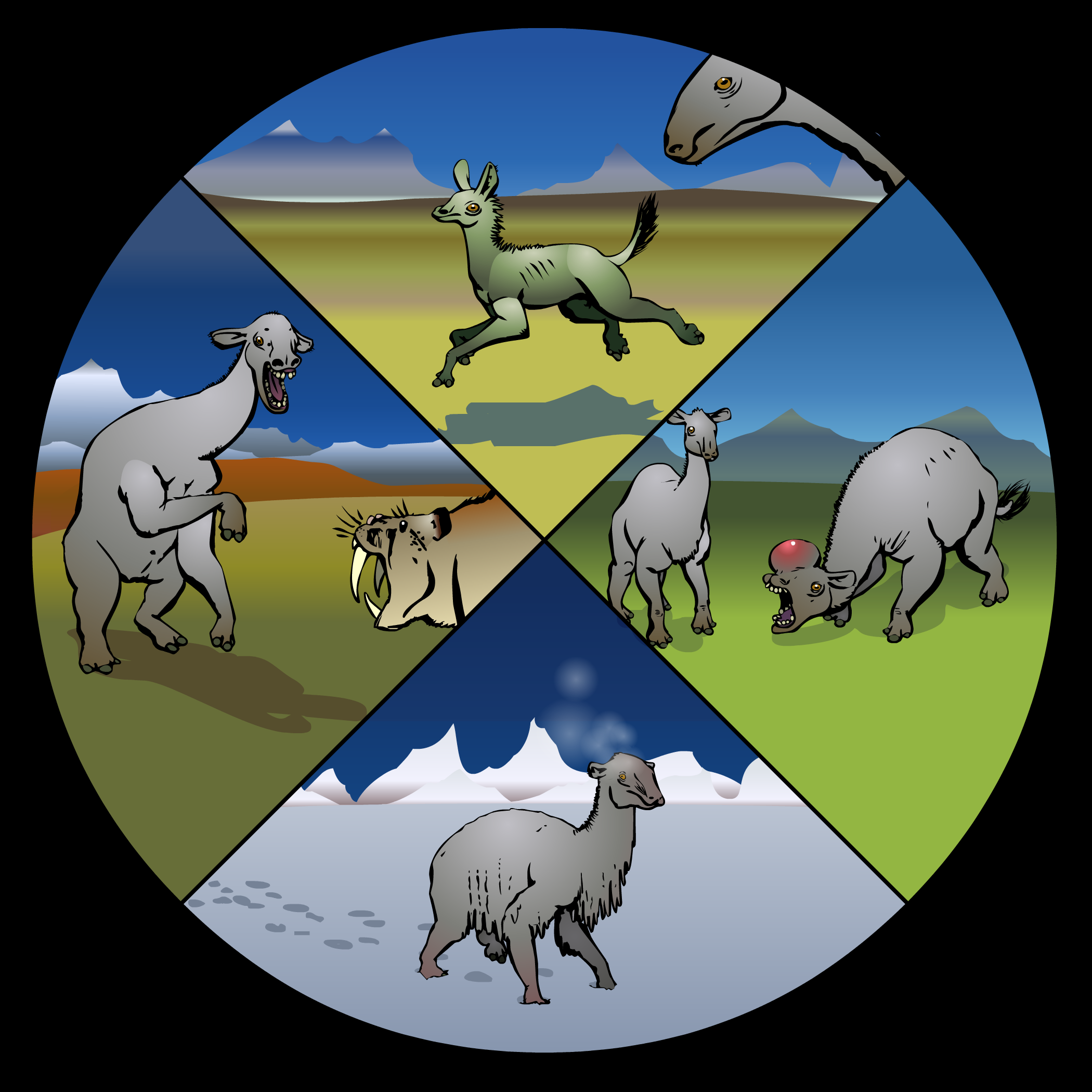
Year of Macrauchenia
Macrauchenia was the greatest and last of the litopterns, a clade of stem-euungulates. This bizarre Pleistocene South American herbivore is often described as having the body of a llama and the head of a tapir. However, the body is only superficially llama-like (but with gigantic elbows) and the head is not at all tapir-like. (If any part of it resembles tapirs, it's the feet.) In fact, the skull isn't like that of any living terrestrial mammal. It has extremely dorsal nares, like trunked animals and cetaceans, but it lacks any place for trunk muscles to attach.
But there is a possible analogue  another group of terrestrial herbivores with extremely dorsal nares  and they even had long necks, too! I refer, of course, to sauropod dinosaurs. Unfortunately, none are extant for comparison, but recent work has shown that, despite the dorsal placement of the nares in the skull, the external nostrils were still placed rostrally, close to the mouth, thanks to fleshy tubes. I've restored Macrauchenia similarly.
This mandala depicts the life of Macrauchenia across the seasons. At bottom, a lone Macrauchenia wanders the frozen highlands in relative comfort, having grown a shaggy winter coat. Its fleshy nostril tubes serve to warm the air before it enters the body. At right, spring is in effect  a bull courts a cow by inflating his nostril tubes, similar to a hooded seal. At top, a young calf frolics under his mother's watchful eye  his green color comes from the algae living in his fur (similar to the camouflage of those other South American indigenes, the sloths). This extra measure of color accuracy is necessary because, unlike today's ungulates, Macrauchenia must contend with predators that have excellent color vision: phorusrhacids. At left, a wary bull faces off against a Smilodon, an invading predator from the north. (It is restored after linsangs, the extant sister group to felids, instead of the felids themselves, since it is, properly, a stem-felid, not a true felid.) Macrauchenia will survive this great faunal interchange, but not for long — another invader from the north, a large primate, will be the end of it, and hence all litopterns.

28 February 2013

Another "All Your Yesterdays" entry: Denisovan, or "Polar Neandertal"

They've extended the deadline for the All Your Yesterdays contest, so I've decided to do a couple more entries. I started this one years ago as a Neandertal restoration. Since that time, new genomic discoveries showed that the speculative pigmentation was incorrect. But, other discoveries identified a new candidate for the subject matter!

Known from a few scrappy pieces, the Siberian Denisovans (Homo sp. or Homo sapiens ssp., depending on how large you like your species) are a true challenge to reconstruct. We have their entire genome, but know almost nothing about their anatomy. The few fossil elements we have are not morphologically distinct from Neandertals (Homo neanderthalensis or Homo sapiens neanderthalensis) or humans (Homo sapiens sapiens).
But the genomic facts are highly intriguing:
  1. Some Oceanian humans have inherited up to 6% of their nuclear DNA from Denisovans (with the highest ratios in Meganesia [Australia and New Guinea]). 
  2. The nuclear DNA indicates a common ancestor with Neandertals, shortly after the split from proto-humans.
  3. But the mitochondrial DNA indicates a motherline that branched off much earlier. (Possibly Homo erectus?)
  4. Genes for pigments are consistent with dark skin.
Here I've imagined a Siberian Denisovan as a sort of "polar Neandertal". As with polar bears, his skin is dark, trapping heat, but his pelage is light, allowing for camouflage against the taiga and tundra. He is the last of his kind — his southern kin mixed with the strange, baby-faced people who keep invading from the west. But he does not welcome them. He will fight to his death.

27 February 2013

"Texan Mama", my "All Your Yesterdays" contest entry

I would have worked on this a bit longer, but the "All Your Yesterdays" contest deadline is tomorrow.
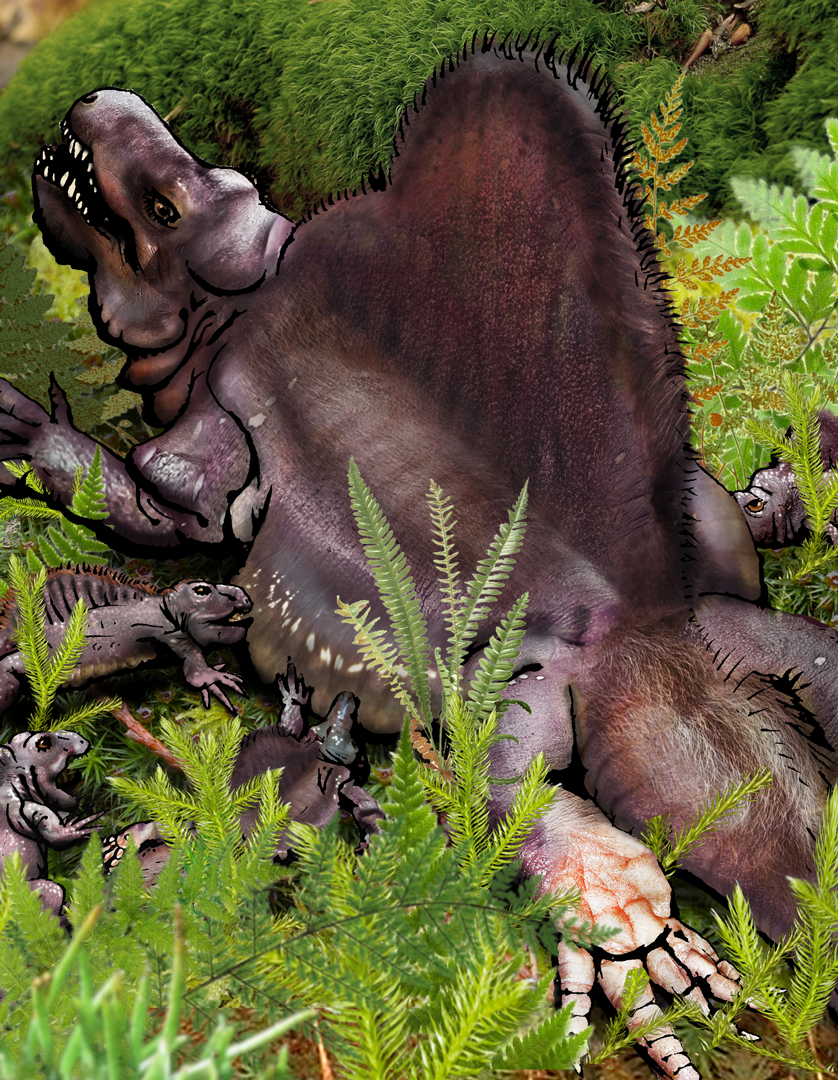
Texan Mama
Dimetrodon and its kin have often been described as "mammal-like reptiles", but in fact they they are just as closely related to modern reptiles as we are (in terms of shared descent). Creatures like Dimetrodon, Moschops, Lystrosaurus, Cynognathus, Morganucodon, etc. are more properly termed "stem-mammals", meaning that they are not mammals, but are more closely related to mammals than to any other living organisms.

We can infer, in the absence of direct evidence, that all stem-mammals probably possessed any characteristics shared by us mammals and our closest living non-mammalian relatives, the sauropsids: turtles, tuataras, lizards (including snakes), crocodylians, and birds. But mammalian characteristics not shared by sauropsids are trickier. When did hair evolve? When did lactation evolve? We have a few clues but no definite answers.

In this piece, I have pushed fur back to an extremely early time — Dimetrodon is one of the furthest stem-mammals from Mammalia proper. While we know that a later stem-mammal, Estemmenosuchus, had glandular skin without any sign of fur, it is possible that fur evolved earlier and was simply lost or reduced in some lineages, as it has been in many lineages of placental mammal.

I have also posited parental feeding, but not, strictly speaking, lactation. Other lineages of tetrapod, including caecilians and pigeons, have evolved ways of feeding the young from foodstuffs produced by the mother. The mother Dimetrodon's sides are swollen with nutritious substances which seep out as her pups gobble it up. Is it milk? Sort of and sort of not.

Finally, I have scrupulously avoided any suggestion that these are in any way reptilian. They do retain some plesiomorphies evidenced in some reptiles, amphibians, and lungfishes, such as a sprawling gait, belly scales, and acute color vision, but they lack the dry skin and derived scales of true reptiles. Not a single sauropsid texture was used in the photocollage; instead they have the textures of Hippopotamus, Phacochoerus, Procyon, Homo, Zaglossus, Caecilia, Litoria, and even Neoceratodus. These Dimetrodon are moist, glandular creatures — not reptiles at all.
If you're wondering, here's a quick breakdown of the textures used:
Hippopotamus amphibius (hippo)
general, especially mother's head and torso
Phacochoerus (warthog)
general, especially mother's tail and torso
Procyon (raccoon)
soles
Homo sapiens (human)
general, especially mother's sail
Zaglossus (long-beaked echidna)
juveniles' faces
Caecilia (caecilian)
mother's sides and underside
Litoria caerulea (Australian green tree frog)
general, especially mother's limbs
Neoceratodus forsteri (Queensland lungfish)
juveniles' underbelly
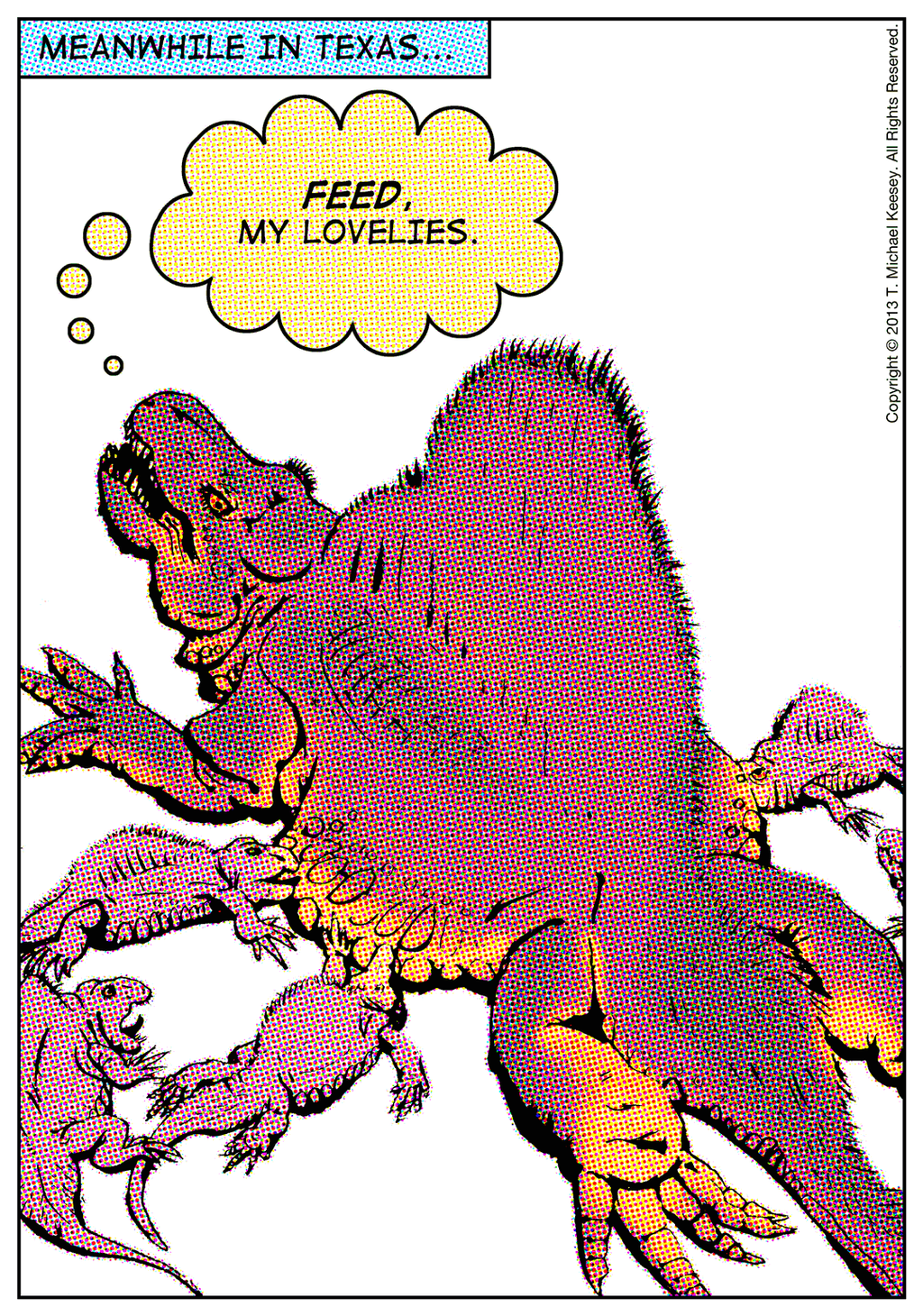
I've also submitted a variant, done in a Pop Art style inspired by Roy Lichtenstein's work, to the related Love in the Time of Chasmosaurs: All Yesterdays contest:


Note: Yes, I do descend from a long line of Texan mothers.

02 January 2013

All Known Great Ape Individuals (Messinian to Present)

Happy 2013, everyone!

Recently I announced a code package I was working on, called Haeckel, for generating vector-based charts related to evolutionary biology. Here's an image I've created using it:

Known Great Ape Individuals
This chart represents all known hominid individuals (Hominidae = great apes, including humans and stem-humans) from the Messinian to the present, erring on the conservative side when the material is too poor to determine the exact number.

If you've been following this blog for a few years you may remember an earlier version of this. I've done a lot of refinement to the data since then. The earlier versions were dissatisfying to me because the horizontal axis was essentially arbitrary. For this version I used matrices from a phylogenetic analysis (Strait and Grine 2004, Table 3 and Appendix C) of craniodental characters to generate a distance matrix, and then inferred positions for other taxa based on phylogenetic proximity and containing clade. This is similar to the metric I used in this chart, except that it incorporates Appendix C, uses inference, and averages distance from humans against distance from [Bornean] orangutans. Don't be mistaken  this is still arbitrary. But it's a bit closer to something real.

Stray notes:
  • I'm pretty sure there are Pliocene stem-orangutans somewhere, right? Might have some work left to do on that data.
  • The dot with no taxon above "Australopithecus" is an indeterminate stem-human from Laetoli. It should probably go further left.
  • The Ardipithecus bubble includes the poorly-known "Australopithecus" praegens. (Although in some runs it moves outside  there's a random element to the plotting.)
  • The Holocene is barely visible up at the top. What a worthless epoch.
  • Homo floresiensis (hobbits) are far to the left of Homo sapiens because I placed them outside Clade(Homo erectus  Homo sapiens).
  • You may recall Lufengpithecus? wushanensis as "Wushan Man", as it was originally placed in Homo erectus. (Hey, it's just teeth.)
  • A couple of fossil chimpanzees, lots of fossil orangutans, but no fossil gorillas. :(
    • (Unless you count Chororapithecus, but that's pre-Messinian. Very pre-Messinian. Suspiciously pre-Messinian....)
  • Look at all that overlap between Homo, Paranthropus, and Australopithecus!
    • I have a feeling, though, that if I added another dimension, Paranthropus and Homo would jut out in opposite directions.
    • Reclassifying Australopithecus sediba as Homo sediba would also decrease the overlap. (Although its position is inferred  actually scoring it might do the same thing.)
    • It's frustrating that the type species of Australopithecus and Paranthropus are also just about the most similar species across the two genera.
  • Kenyanthropus and Praeanthropus have been provisionally sunk into Australopithecus.
  • Should we just sink Orrorin and Sahelanthropus into Ardipithecus? Why not?
  • My guess is that if I added postcranial characters, the stem-humans would all shift right (humanward). Oh, for a good matrix of postcranial characters....
Update
Oh yeah, and if you want a peek at the data, go here.

08 August 2012

How similar are we, anatomically, to other primates?

There is no objective way to measure anatomical similarity, but you can get a sense by converting character matrices into distance matrices. I've done this for the matrix used by Diogo & Wood (2011), which looked at soft tissue anatomy. Here is a bar chart showing how similar each taxon is to humans:


Dangit, 2011, not 2010. I'll fix it later.
Click for full size.
As you can see, the distances for great apes are well-marked and exactly what you'd expect based on phylogeny, but past that it gets a bit fuzzy. Moving outward from the great apes we get to Old World monkeys, then gibbons (from phylogeny you'd expect gibbons first, but the difference is so minor I'm sure it's meaningless), then a mixture of non-catarrhine primates, and finally non-primates.

This figure was generated using a JavaScript library I'm developing. I'll say more later, but rest assured it will be free and open source.

Expect to see some more stuff like this on A Three-Pound Monkey Brain soon.

References


  • Diogo & Wood (2011). Soft-tissue anatomy of the primates: phylogenetic analyses based on the muscles of the head, neck, pectoral region and upper limb, with notes on the evolution of these muscles. J. Anat. 219:273359. doi:10.1111/j.1469-7580.2011.01403.x

13 February 2012

Half a Thousand Silhouettes

Last night PhyloPic reached 500 images! Here's the 500th, a Siberian tiger (Panthera tigris altaicus) by Steven Traver:


Steven submitted 71 silhouettes in the past week! (All vector, too.) I'd like to take a moment to recognize all the people who have submitted silhouettes numbering in the double digits:

26 January 2012

PhyloPic Is Back!

Last year, I launched a project called PhyloPic. The goal of this project was to create an open database of freely reuseable silhouette images of organisms. Furthermore, it featured a phylogenetic taxonomy so that, if a taxon wasn't illustrated, an approximation could be found.

I launched it as a "public alpha", meaning that it wasn't complete and still had some bugs. The year turned out to be very busy for me: an awful thing happened, and a wonderful thing happened. And I didn't really have time to push PhyloPic to the next level.

Unfortunately, I hadn't built it well enough in the first place. The architecture was not optimized, and the site became extremely slow and buggy. I took it offline, hoping to release a new version in short order, but it turned out to need a lot more work than I first thought.

Happily, it is now ready again!

16 January 2012

In Anticipation: The Evolution of the Raven, in Silhouettes

Any day now there will be a relaunch of a certain project I launched last year. (Just working through some technical details.) In anticipation of that, here's the evolutionary history of the Common Raven (Corvus corax), illustrated with silhouettes:

click to enlarge

05 March 2011

PhyloPic Week 2: Lineages, Browsing, and API

Another good week for PhyloPic. There are now well over 200 silhouettes in the database. I also rolled out some new features and enhancements.

Redesigned Lineage Pages

Lineage pages now provide taxonomic and license information for each image. As a visual touch, figures now fade as they go deeper and deeper into the past. Here's a few of my favorite lineage pages so far:
Yes, they're all bilaterian animals. There's a definite bias.

Image Browser

Now you can peruse the entire gallery much more easily, with the Image Browser. Use the arrow(s) on the side to navigate through pages of silhouettes.


Developer API

For any developers out there who want to use the PhyloPic database to create their own apps, now you can. I've provided an initial API, available both as a JSON service and an AMF service for Flex apps.

Also of news to developers: I've opened up the code base for viewing and cloning. (Still need to add the licenses, though.) It's a Django app, written in Python. Feel free to poke around.

Thanks


I'd like to thank everyone who's submitted images so far, especially FunkMonk, Scott Hartman, Matt Martyniuk and Maija Karala for their many contributions. (Each of them has submitted at least a dozen.) Thanks also to Steven Coombs, Craig Dylke, Mo Hassan, Neil Kelley, Dann Pigdon, Ville-Veikko Sinkkonen, Patrick Strutzenberger, Reka Szabo, David Tana, Michael P. Taylor, and Emily Willoughby!

28 February 2011

The First Week of PhyloPic

I announced PhyloPic last week and the response has been great. I launched with ~95 images and we are already up to 170! (Possibly more by the time you read this.) Some of the lineages are becoming pretty complete. Some of the better ones:
For the last one, I made a special collage:

Evolution of the Human

(Click on it and check out the Flickr page to find an extremely high-resolution version.)

Of course, other areas of the Tree of Life are not quite so fleshed out. For example, if you look up a plant you'll usually get this. (Or even less if you didn't happen to pick a tracheophyte.) So there is plenty of illustrating left to do.

There is also plenty of programming left to do. You can see a list of major remaining tasks on PhyloPic's BitBucket page. Here are a few, with links to their pages:
If any of these interest you, I encourage you to vote for them by clicking the "Bump!" button:

And if you have any ideas, you can also suggest features.

At least one blog has created its own PhyloPic feature. Traumador at Art Evolved put together an excellent tutorial on creating silhouettes using Photoshop. (They also posted about PhyloPic here.) Blogger David Tana of Superoceras also awarded PhyloPic his Interweb Science of the Week award.

In summary, the project's going very well and I'm pretty excited about it. I can't wait to see what the rest of the year holds for PhyloPic!

21 February 2011

Introducing PhyloPic: An Open Database of Reusable Silhouettes

Ever had this problem? "Boy, I could sure use a silhouette of [some kind of organism] for this diagram I'm working on. But I can't find anything on the web! Well, except for a few images which are copyrighted...."

What if there were a website with an open database of reusable images, available under Creative Commons licenses? What if you could do phylogenetic searches, so that, even if there weren't a silhouette for the taxon in question, you could at least find something close? What if you could build images like this...


...without having to look all over the web for figures?

Well, now you can! I've launched a new site called:


It's currently in public alpha, which means it's not quite done. So, I have some caveats:

  • I'm pulling most taxonomic data from uBio. It's great because it's really comprehensive. But it's also a huge mess because it stores multiple classifications, many of which are outdated and disagree with each other. (This isn't uBio's fault, as its goal is to store all these classifications, not to offer one nice, neat classification.) So you may (will) find some errata in the phylogenetic system. I'm working on cleaning it up, but there are a lot of taxonomic names out there....
  • It's still early on, so there are only about a hundred images in the database. It will grow over time, but don't be surprised if the closest image it has for your favorite invertebrate is some kind of indiscriminate worm.
  • There are some known bugs (and I don't mean Hemiptera). The Issues Page is open to all, though, so you can read the known issues and report new ones. (Please do!)
It's a work in progress, but I think it has enormous potential. And I think it's reached a state where it's ready for public use and feedback. So have a look, see what you think, and let me know! (And, if you're artistically inclined, please consider submitting some silhouettes of your own.)

01 December 2009

3D March of Man

A while back I started the March of Man project. The goal is to create a massive illustration of human evolution using hundreds of figures. My first attempt involved drawing them by hand on a big piece of paper. I think that lasted about a week.

My second attempt involved a rich web application, where people could submit image files according to certain specifications, and these would be incorporated into a big collage. This got a bit further, but went stagnant for a few reasons: 1) the application is a bit buggy and unwieldy (it was my first big Flex project), 2) drawing each figure still takes a while, and 3) I overestimated the amount of public interest there would be in contributing to this project. (Thanks to Steve O'Connor, though, for being the only other contributor!)

It's been a couple of years since I launched that site, and now I've started on a new method. Will it go anywhere? We'll see. It does solve some problems of the previous approaches.

This time, I'm doing it in 3D. The plan: 1) create a poseable model of an Ardipithecus ramidus female; 2) create morph targets for various other species, ages, and for males; 3) use this to create images for significant localities; 4) combine these into one vast mural.

So far I'm almost done with step #1. Here she is:

Ardi


(Also posted on my sketch blog, Dragabok.)

Still have to tweak the hair a bit and make her poseable. After that, I've got my work cut out for me....

20 November 2009

More Human Evolution Diagrams

I'm nearing the end of work on a review of the case for human evolution. I've uploaded some of the diagrams to my Flickr account before. Some of these were just updated and some new ones were added: see The Case for Human Evolution (Flickr set).

This is probably my favorite of the lot, showing the congruence between morphological/paleontological data (including radiometric dates) and genetic data (including molecular clocks):


(Click to see full size.)


Can you spot the single discrepancy? (No fair reading the caption on Flickr first.)


UPDATE: Revised some of the images, temporarily removed one.