Showing posts with label clade. Show all posts

18 October 2013

The PhyloCode Has a Deadline

As most of you probably know, the PhyloCode (more verbosely, the International Code of Phylogenetic Nomenclature)  is a proposed nomenclatural code, intended as an alternative to the rank-based codes. It was first drafted in April 2000, and at that time the starting date was given as "1 January 200n". On this date the code would be enacted and published along with a companion volume, which would provide the first definitions under the code, establishing best practices and defining the most commonly-used clade names across all fields of biology.


Well, the '00s (the zeroes? the aughts?) came and went without the code being enacted. The hold-up was not the code itself, which has been at least close to its final form since 2007. (The last revision, in January 2010, was minor.) And it hasn't been the software for the registration database, which has been completed. The hold-up was the companion volume, which turned out to be a much more daunting project than expected. (And considering that the zoological code took 66 years to go from being proposed to being published, perhaps the initial estimate should have been hedged, anyway.)

At the 2008 meeting of the International Society for Phylogenetic Nomenclature (ISPN), this problem was discussed. It was decided that the companion volume should be narrowed in scope. Instead of waiting to get definitions for commonly-used clade names across all fields of biology (many of which did not even have willing authors), entries would be limited to those already in progress. Later on, a revision was also made to the editorial process to help speed things up.

Now for some news: at the website for the ISPN (recently revamped by yrs trly), there is a new progress report for Phylonyms, the companion volume to the PhyloCode. There will be at most 268 entries. Currently 186 of those (over two thirds) have already been accepted. The rest are at various stages of review. But perhaps most excitingly, there is a deadline:
The contract with University of California Press calls for the manuscript to be submitted by September 1, 2014.
 Yes, folks, we will see the PhyloCode enacted in our lifetime! (Pending nuclear holocaust or alien invasion.)

15 February 2013

JSEN: JavaScript Expression Notation

That idea I was talking about yesterday? Storing mathematical expressions as JSON? I went ahead and made it as a TypeScript project and released it on GitHub:


JavaScript Expression Notation (JSEN)


Still need to complete the unit test coverage and add a couple more features. I made a change from my original post to the syntax for namespace references. (The reason? I realized I needed to be able to use "*" as a local identifier for multiplication.) They work within Namespace declaration blocks, but I need to make them work at the higher level of Namespaces declaration blocks as well. (Done.) I also want to allow functions to be used as namespaces. (Done.)

This is possible right now:

jsen.decl('my-fake-namespace', {
   'js': 'http://ecma-international.org/ecma-262/5.1',

   'x': 10,
   'y': ['js:Array', 1, 2, 3],
   'z': ['js:[]', 'y', 1]
});

jsen.eval('my-fake-namespace', 'x'); // 10
jsen.eval('my-fake-namespace', 'y'); // [1, 2, 3]
jsen.eval('my-fake-namespace', 'z'); // 2

jsen.expr('my-fake-namespace', 'x'); // 10 // Deprecated
jsen.expr('my-fake-namespace', 'y'); // Deprecated
    // ["http://ecma-international.org/ecma-262/5.1:Array", 1, 2, 3]
jsen.expr('my-fake-namespace', 'z'); // Deprecated
    // ["http://ecma-international.org/ecma-262/5.1:[]", "y", 1]

Eventually something like this will be possible as well:

02 May 2012

The PhyloCode Will Not Be Amended

At least for now.


In a 10-1 decision, the Committee on Phylogenetic Nomenclature voted to reject the wholesale adoption of a proposal to amend the PhyloCode that would have greatly changed how it handles species and species names. However, the CPN has decided to discuss the possibility of using some ideas in the proposal.

02 April 2012

An Idea for the EOL Phylogenetic Tree Challenge

Earlier this year, the Encyclopedia of Life announced the EOL Phylogenetic Tree Challenge. The goal: to produce "a very large, phylogenetically-organized set of scientific names suitable for ingestion into the Encyclopedia of Life as an alternate browsing hierarchy". The prize: an all-expenses-paid trip to iEvoBio 2012 in Ottawa!

This interested me greatly, because:

  1. It's exactly the sort of thing I'm working on for PhyloPic.
  2. I can't really justify paying for a trip to iEvoBio this year. (Phyloinformatics is my hobby, not my profession!)
After reading Rod Page's thoughts on the challenge, I came up with a basic idea, and started to implement it. Unfortunately, now that we're two weeks from the deadline, I'm realizing that:
  1. I do not have the time to complete it.
  2. Even if it were paid for, I can't justify a trip on my own out of town right now.
Why not? Simply put, this.

So, instead, I'm going to outline the general approach I was going to take, and if someone else wants to run with it, knock yourself out. (Just give me partial credit.)

15 February 2012

Amending the PhyloCode: The Species Problem

Earlier I mentioned a proposal by Cellinese, Baum, and Mishler to make a major revision to the PhyloCode, removing pretty much all mention of "species". In this post I'm going to take a high-level look at some of the proposed changes.

16 November 2011

What Is and Is Not a Stem Group

In recent years, I've noticed a trend: the prefix "stem-" is becoming more and more popular for stem groups. For those who don't know what a "stem group" is:

  • A crown group is the last common ancestor or two or more extant taxa, and all descendants thereof.
  • A total group is the first ancestor of a crown group that is not also ancestral to any other extant taxa, and all descendants thereof.
  • A stem group is a total group minus its crown group. (Which means, of course, that a total group is a crown group plus its stem group.)
Or, to put it more simply, an extinct organism is a stem-X if it does not belong to X, but it shares more ancestry with X than with any extant organisms outside of X. Real-life examples:

Velociraptor mongoliensis, a stem-avian.
Illustration by myself (Mike Keesey).
  • Stem-mammals: Dimetrodon, Moschops, Cynognathus, Castorocauda.
  • Stem-avians: Marasuchus, Psittacosaurus, Plateosaurus, Tyrannosaurus, Velociraptor, Archaeopteryx, Hesperornis.
  • Stem-humans: Ardipithecus(?), Australopithecus, Paranthropus, Homo habilis, Homo erectus.
  • Stem-cetaceans: Ambulocetus, Pakicetus, Maiacetus, Basilosaurus.
  • Stem-felines: Proailurus, Smilodon.
  • Stem-pterygotes Stem-neopterans: Dictyoneura, Lithomantis.
This is a great convention. It's consistently useful in every area of the Tree of Life. It's concise. It communicates instantly the general area we're talking about, and sets us up to make proper phylogenetic inferences (when the fossil data is lacking).

So I'm glad this trend is becoming more popular. Unfortunately, I've also noticed another trend: rampant misuse!

Case in point:
  • CABREIRA & al. (2011). New stem-sauropodomorph (Dinosauria, Saurischia) from the Triassic of Brazil. Naturwissenschaften (online early). doi:10.1007/s00114-011-0858-0
This looks to be an excellent paper on a very interesting find, so it's unfortunate that there's a glaring error in the title, but there it is: "stem-sauropodomorph". There is no such thing, because Sauropodomorpha is not a crown group. It doesn't even include a crown group (sadlyit'd be very cool if it did). Rather, all sauropodomorphs are part of the avian stem group.

Panphagia protos, a stem-avian
(not a "stem-sauropodomorph").
Photo by Eva K.
Used under the GFDL.
I see a lot of people making this mistake. I think what's happening is that they're using the basic concept of a stem group, but replacing "total group" with "some large clade" and "crown group" with "an interesting subclade". In this case, Sauropodomorpha is "some large clade" and Sauropoda is "an interesting subclade". (And in that case, the usage is even wronger, because it should at least be "stem-sauropod".)

This misuse is unfortunate because it is subjective, while the proper usage is objective. One could make the argument that the real "interesting subclade" of Sauropodomorpha is Titanosauria, or Neosauropoda, or whatever, and then the terminology would mean something very different. By contrast, e.g., "stem-crocodylian" very clearly indicates a particular paraphyletic group.

So, please, people, use the "stem-" prefix, but use it correctly!

15 September 2011

Soft Tissue Characters Supporting the Great Ape Clades

In my last post, I took a look at some morphological cladistic analyses of hominoids (apes) and tried to compile list of characters that supported the major clades: great apes, African great apes, and mangani (chimpanzees + humans). Unfortunately the studies I looked at only considered skeletal characters (and one of them only craniodental characters). Fortunately, a reader (Dartian) suggested some studies that look at soft tissue characters. I've just skimmed this paper:
  • GIBBS, S., COLLARD, M. & WOOD, B. (2002). Soft-tissue anatomy of the extant hominoids: a review and phylogenetic analysis. Journal of Anatomy 200:349. doi:10.1046/j.0021-8782.2001.00001.x
The authors compiled a matrix of 171 soft tissue characters and found strong support for the topology produced by earlier molecular studies (gibbons, (orangutans, (gorillas, (humans, chimpanzees)))). Below, I've compiled lists of character states that unambiguously support the major clades:

31 August 2011

Characters that Support the Great Ape Clades

Anyone familiar with the current state of great ape phylogeny knows that the following structure is well-supported:
  • Great apes are a clade.
    • Orangutans are a subclade of great apes.
    • African great apes are a subclade of great apes.
      • Gorillas are a subclade of African great apes.
      • Mangani are a subclade of African great apes.
        • Humans are a subclade of mangani.
        • Chimpanzees are a subclade of mangani.
And most such people probably know that the primary evidence for this structure is molecular. But there has to be morphological data to back this up, right?

Great Apes
I've been trying to hunt down such morphological data, but it's been a bit hard. There really aren't that many morphology-based cladistic studies of primates, and the few that exist either exclude humans or focus on stem-humans more than living great apes.

An example of a study that looks at a wide array of fossil and living primates, but fails to include humans:
  • Rossie & Seiffert (2006). Continental paleobiogeography as phylogenetic evidence. Pages 469–522 in Lehman & Fleagle (eds.) Primate Biogeography: Progress and Prospects. Springer, New York. 546pp. isbn:0387298711
An example of a study that includes some living great apes, but focuses on stem-humans:
  • Strait & al. (1997). A reappraisal of early hominid phylogeny. Journal of Human Evolution 32(1):17–82. pmid:9034954
I've compiled some shared character lists from these:

28 February 2011

The First Week of PhyloPic

I announced PhyloPic last week and the response has been great. I launched with ~95 images and we are already up to 170! (Possibly more by the time you read this.) Some of the lineages are becoming pretty complete. Some of the better ones:
For the last one, I made a special collage:

Evolution of the Human

(Click on it and check out the Flickr page to find an extremely high-resolution version.)

Of course, other areas of the Tree of Life are not quite so fleshed out. For example, if you look up a plant you'll usually get this. (Or even less if you didn't happen to pick a tracheophyte.) So there is plenty of illustrating left to do.

There is also plenty of programming left to do. You can see a list of major remaining tasks on PhyloPic's BitBucket page. Here are a few, with links to their pages:
If any of these interest you, I encourage you to vote for them by clicking the "Bump!" button:

And if you have any ideas, you can also suggest features.

At least one blog has created its own PhyloPic feature. Traumador at Art Evolved put together an excellent tutorial on creating silhouettes using Photoshop. (They also posted about PhyloPic here.) Blogger David Tana of Superoceras also awarded PhyloPic his Interweb Science of the Week award.

In summary, the project's going very well and I'm pretty excited about it. I can't wait to see what the rest of the year holds for PhyloPic!

21 February 2011

Introducing PhyloPic: An Open Database of Reusable Silhouettes

Ever had this problem? "Boy, I could sure use a silhouette of [some kind of organism] for this diagram I'm working on. But I can't find anything on the web! Well, except for a few images which are copyrighted...."

What if there were a website with an open database of reusable images, available under Creative Commons licenses? What if you could do phylogenetic searches, so that, even if there weren't a silhouette for the taxon in question, you could at least find something close? What if you could build images like this...


...without having to look all over the web for figures?

Well, now you can! I've launched a new site called:


It's currently in public alpha, which means it's not quite done. So, I have some caveats:

  • I'm pulling most taxonomic data from uBio. It's great because it's really comprehensive. But it's also a huge mess because it stores multiple classifications, many of which are outdated and disagree with each other. (This isn't uBio's fault, as its goal is to store all these classifications, not to offer one nice, neat classification.) So you may (will) find some errata in the phylogenetic system. I'm working on cleaning it up, but there are a lot of taxonomic names out there....
  • It's still early on, so there are only about a hundred images in the database. It will grow over time, but don't be surprised if the closest image it has for your favorite invertebrate is some kind of indiscriminate worm.
  • There are some known bugs (and I don't mean Hemiptera). The Issues Page is open to all, though, so you can read the known issues and report new ones. (Please do!)
It's a work in progress, but I think it has enormous potential. And I think it's reached a state where it's ready for public use and feedback. So have a look, see what you think, and let me know! (And, if you're artistically inclined, please consider submitting some silhouettes of your own.)

02 August 2010

Phun Phylogenies

Pete Buchholz recently started compiling a phylogeny of edible plants, based on the APG III system. I ran it through Names on Nodes and produced a diagram:


A Phylogeny of Edible Plants


(Unfortunately, this version strips out the clade labels—I'll try and rectify that at some point.)


When I saw this, I though, what a fantastic way to learn plant phylogeny! It's something I don't know much about (apart from basics, like the differerence between gymnosperms and angiosperms), and so I found it fascinating to see the ways the foods I eat are related to each other.


It's such a good idea, I couldn't resist doing another version for edible animals and fungi:


And this reminded me of another project I'd been meaning to start for a while, so I finally took a stab at it. A phylogeny of cartoon animals!


(That's right, there's a stuffed tiger clade.)

08 April 2010

Viewing Phylogenies at Different Graph Resolution

Although I've been primarily reining in features on the next version of Names on Nodes, there was a new feature I couldn't resist adding. I think it's coming along pretty well.

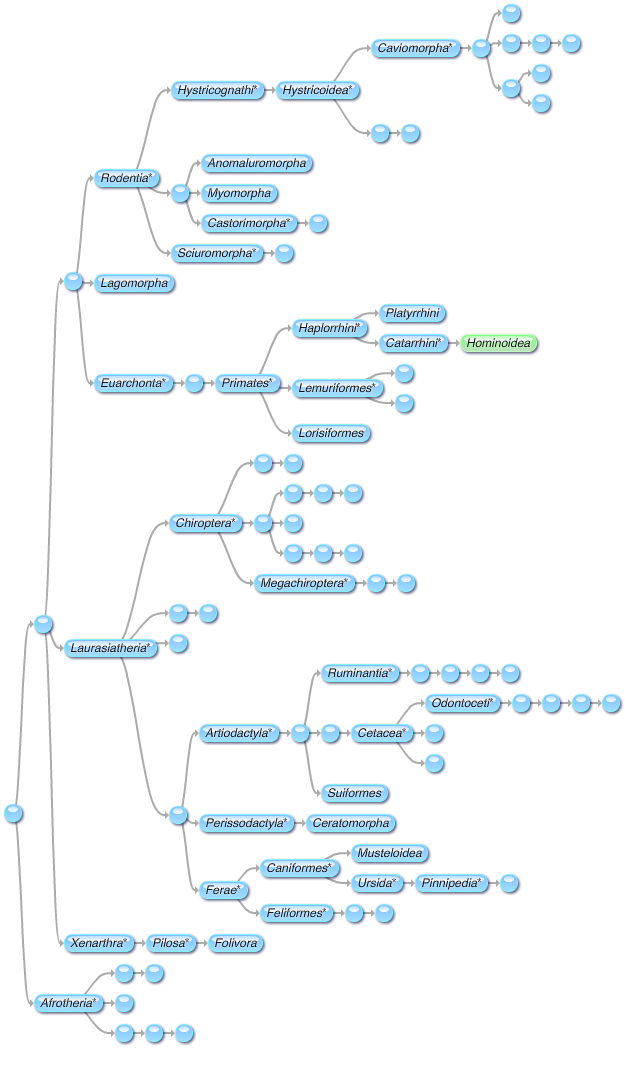
A common problem with working with phylogenies is that many of them are gigantic, far too big to view all at once. As an example, consider Figure 1 from Beck et al. (2006). It models a hypothesis about placental mammal phylogeny, at an arbitrary resolution ("family-level"). Here's how the current version of Names on Nodes renders it:


When you look at it "zoomed out", it's almost impossible to know what's going on. When you look at it full size, you can see various local areas, but you lose a sense of what's going on with the larger image. Note that I've highlighted our own species' twig on the tree (Hominidae, the great ape clade) in yellow.

Earlier I used the term "resolution" to refer to the size of the graph's nodes. We can refer to a graph with very small nodes (e.g., each node representing an individual organism) as being "fine" and a graph with very large nodes (e.g., "class-level") as being "coarse". Thinking about the problem from this angle, I had the idea to create a control for coarsening or refining the viewed graph.

I implemented a simple graph-coarsening algorithm*, and then created an algorithm for picking the best name for the new, coarser graph's nodes. And here is the phylogeny at near-maximum coarseness:


This is placental phylogeny boiled down to its basics: rodents, laurasiatheres, and a bunch of other junk (including us). The node labelled "Placentalia*" contains the placental ancestor but not all descendants—it lacks an unnamed clade included most non-afrothere placentals. The unnamed greenish node includes all members of that unnamed clade except for rodents and laurasiatheres. (This happens to include Hominidae, which is why it has that greenish color.)

Let's refine it one step:


We're starting to get a better idea of the hypothesis. Finer:


Now we can see the basal split between afrotheres and other placentals, as well as developing complexity in Rodentia and Laurasiatheria. Finer:

Getting a little bit on the big side, now, but we can see more details. There are a lot of unnamed clades within Hystricoidea and Chiroptera—we can see that those clades are diverse, although we can't see details. Finer:
This has about 2/5 as many nodes as the base graph. It's a bit large, but still much easier to view than the base graph. Many important details are visible (e.g., the platyrrhine-catarrhine split), while others are just suggested (e.g., lots of diversity in Caviomorpha).

Obviously this works best if lots of clades have been named. I think it'll be a useful for boiling a phylogeny down to an appropriate level: coarser for quick overviews, finer for in-depth discussion.


* Basic summary of the coarsening algorithm:
  1. Look through all nodes that have children, and find the ones whose children are all terminal (sinks).
  2. Merge each of those nodes with their children to create a "supernode".
  3. Merge all overlapping supernodes. (This is important for graphs where nodes may have multiple ancestors, although it doesn't come into play in this example.)
  4. Remove the supernodes from the graph and repeat from step 1. Keep going until no nodes are left.
  5. Add the supernodes to a new graph. A supernode is ancestral to another supernode if any of its subnodes are ancestral to any of the other supernode's subnodes.

01 March 2010

The Great PhyloCode Land Run

Sometime in the near future, the PhyloCode will be enacted. For this to happen, two things need to happen concurrently:

1. The registration database (called "RegNum") must be completed and opened to the public. This is necessary because the PhyloCode requires all names to be registered electronically.

2. Phylonyms: a Companion to the PhyloCode must be published. This is a multi-authored volume that will include the earliest definitions under the PhyloCode.

Which names will be defined in Phylonyms? The original goal was to cover the most historically important names (what Alain Dubois calls "sozonyms"). However, proponents of phylogenetic nomenclature tend to be clustered in several fields (most notably vascular plant botany and vertebrate zoology—note that the code's authorship reflects this). This means certain parts of the Tree of Life (e.g., entomology) will unfortunately be underrepresented, due to lack of interest in those fields. (The alternative, having non-specialists define such names in Phylonyms, does not bear consideration.) So Phylonyms will be less about providing coverage and more about providing sturdy, well-reasoned definitions that can serve as examples.

What about all the names that it omits? What will happen to those once the PhyloCode is enacted? That will be interesting to see.


One thing I could envision is a sort of "land run". I picture it working this way. Let's consider a field, say, anthropology, where phylogenetic nomenclature has not taken much of a hold. Currently there is debate about how to use some taxonomic names related to the field. Some workers like to use the familial name "Hominidae" to refer to a large taxon, including humans and great apes. Others prefer to restrict it to the human total clade (i.e., humans and everything closer to them than to other extant taxa). Similarly, some workers use the generic name "Homo" in a broad sense to include short, small-brained species like Homo habilis, while others prefer to restrict it to the tall, large-brained clade (relegating H. habilis to another genus, e.g., Australopithecus).

Let's say there's a researcher out there named Dr. Statler, who prefers a strict usage for "Hominidae" and a broad use for "Homo". But his colleague, Dr. Waldorf, prefers a broad usage for "Hominidae". Dr. Waldorf isn't really that interested in phylogenetic nomenclature, but when he notes that "Hominidae" is not in the registration database, he sees an opportunity. He writes a quick paper defining "Hominidae" as a node-based clade: "The clade originating with the last common ancestor of humans (Homo sapiens Linnaeus 1758), Bornean orangutans (Pongo pygmaeus Linnaeus 1760), common chimpanzees (Pan troglodytes Oken 1816, originally Simia troglodytes Blumenbach 1775), and western gorillas (Gorilla gorilla Geoffroy 1852, originally Troglodytes gorilla Savage 1847)."

Dr. Statler is, of course, outraged. Not that he cares that much about phylogenetic nomenclature, but what if anthropologists do start using it? What if someone ruins another taxonomic name? His colleagues Drs. Honeydew and Beaker prefer a strict definition of "Homo"—what if they author a paper cementing that definition under the PhyloCode?

This cannot come to pass! Dr. Statler does some reading on the code and decides that a branch-based definition would work nicely for his broader usage. He defines "Homo" as, "The clade consisting of Homo sapiens Linnaeus 1758 and all organisms that share a more recent common ancestor with H. sapiens than with Australopithecus africanus Dart 1925, Paranthropus robustus Broom 1938, Zinjanthropus boisei Leakey 1959, or Australopithecus afarensis Johanson & White 1978." This sets off another anthropologist, and soon all sorts of anthropological/primatological names are being defined under the PhyloCode, as workers struggle to assert their usages.


This is not an ideal situation. It would be much nicer if a group of anthropologists were to come together, discuss the matters rationally, and arrive at an agreement which they then publish together. But it's still not a horrible situation—at least people are defining phylogenetic names and at least interest in phylogenetic nomenclature is being spread. I can't predict the future, but I feel like this sort of "land run" is bound to occur at least in some fields—and maybe that's okay.

25 February 2010

Tricksy Definitions Expressed Mathematically

Just for fun, here are a few definitions of nonstandard type to go along with those in the previous post. As any practitioner of phylogenetic nomenclature knows, most definitions are node-, branch-, or apomorphy-based, but there have been a few that don't fall into these categories.

Here are Wagner's (2004) definitions of Panbiota and Biota:

   Panbiota := (Cladeprc)(Homo sapiens).

   Biota := Crown(Panbiota, "extant as of or after 2004").

This is one of the few cases where it makes more sense to define the crown clade based on the total clade rather than vice versa. (Maybe the only case? Not sure.) Technically, Wagner's wording for the definition of Panbiota might be better translated as (sucminprc)(Homo sapiens), but it works out to the same thing.

And here's Clarke's (2004) definition of Ichthyornis:

   Let M := "apomorphy 2" ∩ "apomorphy 5" ∩ "apomorphy 6" ∩ "apomorphy 7" ∩ "apomorphy 8".
   (These refer to apomorphies in Clarke's Ichthyornis dispar Diagnosis.)

   Ichthyornithes := Clade(YPM 1450 Struthio camelusTinamus majorVultur gryphus).
   ("YPM" refers to the Yale Peabody Museum's Vertebrate Paleontology collection. YPM 1450 is the Ichthyornis dispar holotype specimen.)

   Ichthyornis := Clade((M @ YPM 1450) ∩ Ichthyornithes).

Names on Nodes: MathML Definitions (Version 1.1)

After posting Version 1.0 earlier this week, I had a revelation: the cladogen functions are completely unnecessary, and everything would work a lot nicer if I just tossed them. I also realized that there really was no reason I couldn't include the various relations (precedence, immediate precedence, proper precedence, etc.), just in case anyone wanted to do some seriously non-standard definitions. After some significant revisions, I present Version 1.1.

Some examples of the updated notation, using humans (Homo sapiens), platypuses (Ornithorhynchus anatinus), and Dimetrodon grandis, a stem-mammal:

Union. Homo sapiensOrnithorhynchus anatinus = all humans and all platypuses (polyphyletic taxon, also monothetic)

Exclusive Predecessors. Homo sapiensOrnithorhynchus anatinus = humans and all of their ancestors, except for the ancestors shared with platypuses (lineage)

Synapomorphic Predecessors. "milk glands" @ Homo sapiens = humans and all human ancestors to possess milk glands synapomorphic with those in humans (lineage)

Node-Based Clade. Clade(Homo sapiensOrnithorhynchus anatinus) = Mammalia

Branch-Based Clade (simple). Clade(Homo sapiensOrnithorhynchus anatinus) = "Pan-Theria"

Branch-Based Clade (multiple external specifiers). Clade(Homo sapiensOrnithorhynchus anatinusDimetrodon grandis) = "Pan-Theria"

Branch-Based Clade (multiple internal specifiers). Clade(Homo sapiensOrnithorhynchus anatinusDimetrodon grandis) = (unnamed clade comprised mostly of Therapsida)

Null Branch-Based Definition (multiple internal specifiers). Clade(Homo sapiensDimetrodon grandisOrnithorhynchus anatinus) = ∅

Apomorphy-Based Clade. Clade("milk glands" @ Homo sapiens) = "Apo-Mammalia"

Node-Modified Crown Clade. Crown(Homo sapiensDimetrodon grandis, "extant as of or after 2010") = Mammalia

Branch-Modified Crown Clade. Crown(Homo sapiensOrnithorhynchus anatinus, "extant as of or after 2010") = Theria

Apomorphy-Modified Crown Clade. Crown("milk glands" @ Homo sapiens, "extant as of or after 2010") = Mammalia

Total Clade. Total(Mammalia, "extant as of or after 2010") = Synapsida (or "Pan-Mammalia")

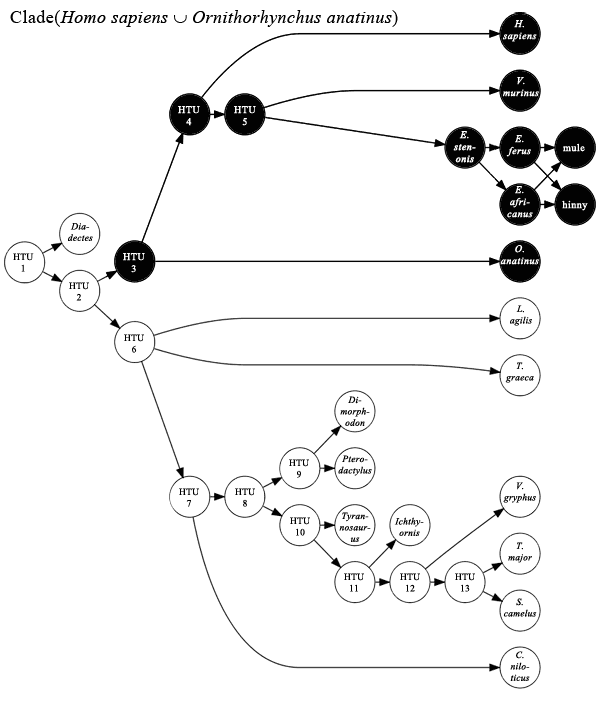
Image showing a node-based clade (Mammalia) under a given phylogenetic hypothesis. Click to enlarge. More here.

22 July 2009

"The Case for Human Evolution" - Illustrations

I have been working on an essay entitled The Case for Human Evolution for a while. I've just posted some illustrations I've been working on:


Enjoy!

12 February 2009

Extinct or Extant?

It's pretty easy to tell whether something's alive, right? You might have to jab it with a stick a couple of times to make sure (assuming it's an animal), but generally it's not too hard. So you'd think.

The International Union for Conservation of Nature is devoted to the preservation of life's diversity, so, naturally, it has a big stake in this question. When should we expend energy to try to save a critically endangered species, and when should we throw in the towel? Their Red List Guidelines say this about extinction:
Extinction is defined as population size reaching zero.
That made me laugh when I first read it. Really? You don't say! But I read on, and it became clear that there was much more to this seemingly simple definition:
Population size is the number of all individuals of the taxon (not only mature individuals). In some cases, extinction can be defined as population size reaching a number larger than zero. For example, if only females are modelled, it is prudent to define extinction as one female (instead of zero) remaining in the population. More generally, an extinction threshold greater than zero is justified if factors that were not incorporated into the analysis due to a lack of information (for example, Allee effects, sex structure, genetics, or social interactions) make the predictions of the analysis at low population sizes unreliable.

For Criterion E, extinction risk must be calculated for up to 3 different time periods:
  • 10 years or 3 generations, whichever is longer (up to a maximum of 100 years)
  • 20 years or 5 generations, whichever is longer (up to a maximum of 100 years)
  • 100 years
For a taxon with a generation length of 34 years or longer, only one assessment for 100 years) is needed. For a taxon with a generation length of 20 to 33 years, two assessments (for 3 generations and 100 years) are needed. For a taxon with a generation length less than 20 years, all three assessments are needed.
This is just a small sample of what the IUCN has to say on the subject. So much for just poking things with sticks.

It would be nice if we could simply categorize species as extinct or extant, but it's not always easy. A species may be extant one day and extinct the next. And we may not realize this until years or even decades later. Or, we may think a species extinct only to have individuals turn up again, as may have happened with Campephilus principalis, the ivory-billed woodpecker, a few years ago (Hill et al. 2006).

This question is important not only for conservation efforts, but also for nomenclature. In fact, in some ways, the issues become even thornier for nomenclature. To see why this is so, let's look at the phylogenies of two mammalian taxa.

Whales

Whales, or cetaceans, are related to even-toed ungulates, or artiodactyls. (In fact, they may even be artiodactyls, but that's a discussion that I'm going to try to avoid as much as possible right now.) The chart below shows a sampling of fossil and living species, giving a very rough and highly abridged picture of cetacean evolution:

Time goes from left to right. Arrows point from ancestor species to descendant species. Silhouettes are not to scale.

Cetacea is what we call a "crown group". A crown group is a special type of clade, a clade being an ancestor and all of its descendants. A crown group is the final common ancestor of certain extant organisms, and all descendants of that ancestor. Note that this doesn't mean that all members of a crown group are extant; for example, Aetiocetus, a proto-baleen whale known from fossils, is long extinct. But it is descended from the final common ancestor of living baleen whales (Mysticeti) and living toothed whales (Odontoceti), so it is still a member of the crown group Cetacea.

The cetacean "total group", informally termed "pan-Cetacea", includes everything sharing closer ancestry with cetaceans than with any other extant organisms. A number of extinct taxa, from Pakicetus to Dorudon, are members of the total group, but not of the crown group. Therefore, they are part of the cetacean "stem group", or, more succinctly, "stem-cetaceans". (Indohyus may also be a stem-cetacean, but there are differing hypotheses.) Note that the stem group includes the ancestors of the crown group, but not all members of the stem group are ancestors of the crown group. For example, Basilosaurus cetoides is a stem-cetacean, but it is a somewhat derived offshoot of the cetacean lineage, with a long, snake-like body different from that of modern cetaceans or their ancestors.

Somewhere around the time of the Cretaceous-Paleogene extinction (when non-avian dinosaurs, among many other taxa, became extinct reached a population size of zero), the cetacean line split off from other extant lineages (either from the hippopotamid lineage, the ruminant lineage, or both at once—the artiodactyl lineage). The earliest stem-cetaceans were hoofed, but they soon gave way to amphibious varieties, which looked vaguely like mammalian crocodiles with flippers. Over time, adaptations toward an aquatic lifestyle were accumulated in stem-cetacean populations: tail flukes, dorsal fins, birth in the water. Stem-cetaceans were replaced by cetaceans, which possessed all of these adaptations. Early cetaceans split into two major lineages: one leading to the filter-feeding mysticetes and the other to the echolocating, predatory odontocetes.

Many living species of cetacean are threatened. Perhaps the worst case is that of the Yangtze River dolphin or baiji, Lipotes vexillifer. This human-sized freshwater cetacean was once one of the few animals to be actually protected by superstition (many others, instead, are endangered by it—think of rhinoceros horns as an ingredient in impotence remedies). But, in modern times, this protection has come to mean less. The last uncontested sighting of a baiji was in 2004. The IUCN currently classifies the species as critically endangered, but it may be extinct already. If so, it would be the first aquatic mammal species to go extinct in the 3rd millennium—less than a decade in and we're already off to a bad start.

Not all zoologists use Cetacea in the crown group sense; some paleontologists expand it to include some or all of the stem group. But there is a danger in doing this. Cetacea is primarily a term from the neontological (as opposed to paleontological) literature, so it is most often associated with the suite of characters that the living organisms possess. But members of the stem group may or may not possess these. A recent, spectacular discovery of a fossilized, pregnant Maiacetus (which would go in the above chart somewhere around Rodhocetus) shows that Maiacetus probably gave birth on land. It is not known (to me, anyway) whether they had dorsal fins or tail flukes.

Since extending neontological terms beyond the crown group can result in unwarranted character inferences, some systematists prefer to limit such terms to crown groups when possible. The PhyloCode, a nomenclatural code currently in draft form, advocates this approach (see, for example Recommendation 10.1B). (The PhyloCode is also the source of the "pan-" convention for the names of total groups; see Art. 10.3.)

Moving too fast? Let's slow down....

Sloths

Although today's sloths, or Folivora ("leaf-eaters"), are tree-dwellers, many in the past were terrestrial; some were even amphibious (living sloths are good swimmers when they need to be). Modern sloths exist in two clades: Bradypus, the three-toed sloths, and Choloepus, the two-toed sloths. The closest living relatives to sloths are Vermilingua ("worm-tongues"), or "true" anteaters (not to be confused with other long-tongued mammals that feed on eusocial insects, such as aardvarks, numbats, and echidnas). Together, sloths and anteaters comprise a clade called Pilosa ("hairy ones"). All living pilosans are Neotropical, although some fossil taxa were Nearctic (as are some of their cousins, the armadillos, or Loricata).

Here is a phylogeny with a sampling of species to give an overview of sloth evolution (again, highly abridged, to say the least):

Time goes from left to right. Left-right lines connect ancestor species to descendant species. Silhouettes are not to scale.
Note that I've flipped the living sloths upside-down ... err, right-side-up ... err ... never mind.
The sloth lineage split from its stem-anteater kin during the Paleocene. The original sloths were terrestrial, but at least two clades became highly arboreal (Bradypus and Choloepus, mentioned before). One clade, including Thalassocnus, went in a different direction and became amphibious. Most lineages, however, remained terrestrial, one of them culminating in the enormous Megatherium americanum, a sloth the size of an elephant.

If you look at the above diagram, you might think, "But, look, there are more than just two extant groups." This is because the diagram is on such a vast scale that it's impossible to distinguish the extant from the recently extinct. Here's the same phylogeny to a logarithmic scale, which expands recent time:


Now we can actually see the Holocene, or "Recent", our current geological epoch (unless you accept the Anthropocene—more on that later). And you can see that some taxa, such as Mylodon and Megatherium, died out around the Pleistocene-Holocene transition. This transition was only 11 to 12 thousand years ago (an eyeblink in geological time, as can be seen by the fact that it's not even visible in the first chart).

Some Haitian sloth species persisted until much more recent times. Parocnus serus and Synocnus comes were still hanging around (ha ha—just kidding, they were more or less terrestrial) when European explorers first came to the Caribbean. They may have died out in the 16th century C.E.

Sloths present an interesting case because the clades that can be considered crown groups have changed over the course of human existence. Twelve thousand years ago, when humans were still settling the New World, a sloth crown group would have included Mylodon, and within that group a smaller crown group would have included Choloepus, Hapalops, Thalassocnus, Megatherium, Synocnus, and Parocnus. (Thalassocnus and Hapalops were extinct, but would still be part of that crown group.) After the Holocene-Pleistocene extinctions, Mylodon would no longer be part of the sloth crown group, and the Choloepus-but-not-Bradypus crown group would no longer contain Thalassocnus, Megatherium, or Hapalops. This continued, more or less, until the European/African settling of the Caribbean, at which time Synocnus and Parocnus died out.

Today, some species of Bradypus (B. pygmaeus and B. torquatus) are endangered. Time will tell if conservation efforts win out, or if the Bradypus crown group shrinks further.

Defining Crown Groups

I've been talking about crown groups changing over time, but we need nomenclature to be stable. (Why? Well, for one thing, so we can communicate effectively about conservation efforts.) One way to do this is to tie names to phylogeny-based definitions. This is how the PhyloCode works.

There are three major ways to define a crown group:

1. Node-Based Definition

This is the simplest way: just build up a list of extant specifiers, take their final common ancestor, and add all descendants. As an example, we could define Cetacea as the clade originating with the final common ancestor of Balaena mysticetus Linnaeus 1758 and Delphinus phocaena Linnaeus 1758 (=Phocoena phocaena Gray 1825). One advantage of this type of definition is that we don't need to worry about the meaning of "extant".

There is a peril with this approach, though: what if a new phylogenetic hypothesis shows some member to be outside the delimited clade? Fortunately the PhyloCode allows for expedient "unrestricted" emendations in such cases (i.e., minor, commonsense emendations that don't require committe approval; see Art. 15). But ideally the need for such emendations should be avoided. One way to avoid this need is with modified node-based definitions, which come in two major flavors.

2. Branch-Modified Node-Based Definition

In this approach, we create a node-based definition using all extant members of a given total group. For example, the cetacean total group could be defined as everything sharing closer ancestry with B. mysticetus than with Hippopotamus amphibius Linnaeus 1758 or Bos taurus Linnaeus 1758. Thus, Cetacea could be defined as the clade originating with the final common ancestor of all extant organisms that share a closer common ancestor with B. mysticetus than with H. amphibius or B. taurus.

There are two pitfalls to this approach. One is that you might fail to specify the closest extant outgroup. For example, if pigs (suids) turned out to be closer to whales than cattle or hippos are, then, under that definition, pigs would be cetaceans! Again, this can be fixed with an unrestricted emendation, but it would be nice not to have to do that.

The other pitfall is that the author(s) must define "extant", but more on that later.

3. Apomorphy-Modified Node-Based Definition

This style of definition uses a derived character, or "apomorphy", to delimit a clade, and then creates a node-based clade using the members of that apomorphy-based clade. This requires some apomorphy that evolved within the stem group. Cetacea, for example, could be defined as the clade originating with the final common ancestor of all extant organisms that possess tail flukes homologous (synapomorphic) with those of B. mysticetus.

There are two pitfalls with this approach. One is that the apomorphy may turn out not to have evolved within the stem group. It may have evolved earlier, thus expanding the content of the clade, or it may have evolved independently multiple times within the crown group, thus contracting the content of the clade. (It must be said, though, that in the case of cetacean tail flukes, both possibilities are extremely unlikely.)

The other pitfall is the same as that of branch-modified node-based definitions: what does "extant" mean? Extant when? And by what criteria? Let's look at this in more depth.

The Many Flavors of "Extant"

Although many of the PhyloCode's articles deal with crown groups and total groups, the code doesn't provide a single definition of "extant". Instead, the author of the definition must select a meaning. The author has considerable latitude here. If nothing is specified, there is a default fallback: extant at time of publication (Art. 9.5).

Recent (Holocene)

In just about every place that the PhyloCode uses the word "extant", it is followed with a parenthesis: "(or Recent)". In other words, a crown group may be considered as a clade originating with the final common ancestor of Holocene organisms.

I find this problematic for a couple of reasons. One is that the Holocene covers all of human history and more, so just being Holocene is no guarantee that we'll have good specimens. Some Holocene species went extinct thousands of years before Sumerians ever put wedge to clay tablet. Look at the sloth phylogeny—some of the species, such as Mylodon sp. and M. americanum, seem to have gone extinct right before the Holocene. But what if some small populations endured for a short while in refugia? That could drastically change the content of, e.g., a branch-modified node-based clade including Choloepus but not Bradypus.

The other problem is that "Recent" doesn't really get at the reason why crown groups are interesting. They're interesting because we have a wealth of available data about some of their members, data which can be used to extrapolate ancestral states. The same amount of data is not present for stem groups, which are generally known from fossils, if they are known at all.

Non-Fossil Specimens

Philip Cantino, one of the authors of the PhyloCode, once told me (pers. comm.) his opinion on what "extant" should mean: "I think that any species that was extant recently enough to be represented in museums in a non-fossilized form (e.g., study skins, herbarium specimens) should be treated as extant." Note one big advantage of this approach: it's much simpler to verify whether something is extant.

This approach also gets closer to the basic intent of crown groups. Extra data are available in non-fossil specimens. But it's still short of the data present in living forms; for example, behavior is not observable. Is it enough extra data to warrant recognizing the species as extant for nomenclatural purposes? It boils down to opinion. (And I note that behavior might not be a very important consideration for Phil's purposes, since he works on plants.)

This idea has direct relevance for sloths, because one extinct form is actually represented by non-fossil specimens! Mylodon skins, complete with armor nodules and fur, still exist, having been preserved in caves. Supposed that Folivora were defined as the clade originating with the final common ancestor of all extant organisms sharing closer ancestry with Bradypus tridactylus Linnaeus 1758 than with Myrmecophaga tridactyla Linnaeus 1758 (the giant anteater). The question of whether Mylodon is extant would determine whether an entire clade (Mylodontidae) belongs to Folivora. (Of course, nobody says that has to be the definition of Folivora, or even that Folivora has to be a crown group, but this is just an example.)

Anthropocene

Although the Holocene is already a ridiculously short geological epoch, Cruzen and Stoermer (2000) proposed naming a new, much shorter geological epoch for the Industrial Age. They named the "Anthropocene" in recognition of the global effects that Industrial-Age humans have had upon the environment, and set its starting date as 1784 C.E., with James Watts' invention of the steam engine. (This is also, not coincidentally, around the time that certain effects of pollution start to appear in ice core samples.)

This designation hasn't met widespread adoption, to my knowledge, nor has it been proposed as a criterion for determining whether a species is "extant" for the purposes of nomenclature. But it seems to me like a better candidate than the Holocene. At least Anthropocene species have all coexisted with scientists.

Living at a Given Time in History

A similar candidate to using the Anthropocene, was proposed in a bulletin board discussion by Mike Taylor. Under this proposal, anything living during or after 1758 C.E. would be considered extant, 1758 being the year that the 10th edition of Linnaeus' Systema Naturae was published. That publication is regarded as the beginning of biological nomenclature by the botanical and zoological codes.

Both of these approaches (Anthropocene and Systema Naturae) have similar problems to the use of "Recent", although to a lesser extent. It's difficult to establish whether some species went extinct before or after the selected boundary. For example, the sloths Synocnus and Parocnus probably went extinct a couple of centuries earlier than these dates, but it's possible that they persisted in remote areas. An even closer example is Hydrodamalis gigas, Steller's sea cow, which seems to have gone extinct by 1768 (post-Systema Naturae, pre-Anthropocene!).

Living Now

Right now. Wait, I mean NOW. Wait ... no ... okay ... NOW.

Well, there is no one "now". Every instant is its own "now". Obviously, I mean something closer to the PhyloCode's default definition: extant as of the publication date of the definition.

This is less problematic than using earlier dates in some ways. We have much better ways of tracking populations today than we did in the 1700s. But pushing the date closer to the present also presents problems. Consider Steller's sea cow and the Yangtze River dolphin. It's easy to say that the sea cow is extinct, but the fate of the dolphin is still as unclear as the muddy waters it swims (or swam?) in. Consider: what if, despite the phylogeny presented above, Lipotes was found to be an outgroup to [other] extant cetaceans? Would the cetacean crown group include it or not? (Thanks to Matt Martyniuk for thinking of that example.)

And all of the meanings mentioned so far share another problem: the discovery of a previously unknown species could change everything. There are many example of "Lazarus taxa" (so-called because, like the character of Lazarus in the Christian gospels, they appear to rise from the grave), living organisms that represent clades previously known only from fossils: the Laotian rock rat, Laonastes aenigmamus (Diatomyidae); the Indian Ocean coelacanth, Latimeria; the gladiators, Mantophasmatinae (Insecta: Mantophasmatodea); the monito del monte, Dromiciops gliroides (Marsupialia: Microbiotheria); the Wollemi pine, Wollemia nobilis (Araucariaceae: Wollemia); etc. Although the discovery of such a species is always a wonderful event, it's potentially disruptive to modified node-based definitions.

Living And Published Upon

This last problem can be easily remedied, though: just require that something must be extant and published upon at the time of the definition. This could go a long way toward stabilizing definitions. The only drawback is that it could be seen as a bit arrogant: "If science hasn't heard of it, then it doesn't exist!" But this is only for nomenclatural purposes (of course Wollemi pines make a sound when they fall, whether scientists hear it or not).

But this still doesn't solve the problem of whether Lipotes is extinct or extant.

Let Someone Else Worry About It

The IUCN has put tons of thought and effort into these sorts of questions. One possibility would be to simply leave the question up to their Red List and let them worry about particulars. If I want to know if species X was extant in 2004, I check their database and see if its designation was something other than "extinct" for that year. They may not always be able to pinpoint the exact time of death for every species, but they do as good a job as anyone, or better.

Of course, the IUCN doesn't cover all species, leaving out 1) species that have been extinct for a long time (e.g., Tyrannosaurus rex), and 2) species that haven't been published by scientists yet (e.g., Laonastes aenigmamus in lists prior to 2005). But I think in both of these cases we can consider such species to be "non-extant for the purposes of nomenclature". Long-extinct species are clearly not extant. Treating undiscovered species as non-extant has the same stabilizing benefit as requiring an extant species to be published upon. The only problem spot is the taxa that the IUCN doesn't focus on, e.g., bacteria and archaeans. But this still leaves plenty of taxa that it works just fine for.

I think I like this approach best, at least for the taxa I study (amniotes). Delegate the issue to the experts. Mylodon and Synocnus are extinct. Lipotes is critically endangered (at least as of last year). The nomenclatural problem is taken care of, and we can move on to more crucial problems, like preserving the crown groups that we have.

21 October 2008

Six Ways to Say the Same Thing

Prose
"'Aves' refers to the crown clade stemming from the most recent common ancestor of Ratitae (Struthio camelus Linnaeus 1758), Tinamidae (Tetrao [Tinamus] major Gmelin 1789), and Neognathae (Vultur gryphus Linnaeus 1758)."
—Jacques Gauthier & Kevin de Queiroz 2001 December


Simple Mathematical Formula

Aves := Clade(Struthio camelus + Tetrao major + Vultur gryphus)


Complex Mathematical Formula

Aves Linnaeus 1758 [Gauthier & de Queiroz 2001] := (AD o max o CA)(Struthio camelusTetrao majorVultur gryphus)


Ridiculously Complex Mathematical Formula

C := {x : (∀y ∈ (Struthio camelusTetrao majorVultur gryphus))[xy]}
A := {xC : (∀yC)[xy]}
Aves := {x : (∃yA)[xy]}


Simple MathML-Content
<apply>
xmlns="http://www.w3.org/1998/Math/MathML"
<csymbol
definitionURL="http://namesonnodes.org/2008/phylo/math/nodeClade"/>
<csymbol
definitionURL="urn:isbn:0-85301-006-4/Struthio+camelus"/>
<csymbol
definitionURL="urn:isbn:0-85301-006-4/Tetrao+major"/>
<csymbol
definitionURL="urn:isbn:0-85301-006-4/Vultur+gryphus"/>
</apply>

Complex MathML within Custom Markup
<pn:definition
xmlns="http://www.w3.org/1998/Math/MathML"
xmlns:pn="http://namesonnodes.org/2008/phylo/names">
<apply>
<csymbol
definitionURL="http://namesonnodes.org/2008/phylo/math/clade">
<mi form="prefix">Clade</mi>
</csymbol>
<apply>
<csymbol
definitionURL="http://namesonnodes.org/2008/phylo/math/nodeAncestors">
<mo form="infix">+</mo>
</csymbol>
<csymbol
definitionURL="urn:isbn:0-85301-006-4/Struthio+camelus">
<![CDATA[<i>Ratitae</i> (<i>Struthio camelus</i> Linnaeus 1758)]]>
</csymbol>
<csymbol
definitionURL="urn:isbn:0-85301-006-4/Tetrao+major">
<![CDATA[<i>Tinamidae</i> (<i>Tetrao</i> [<i>Tinamus</i>] <i>major</i> Gmelin 1789)]]>
</csymbol>
<csymbol
definitionURL="urn:isbn:0-85301-006-4/Vultur+gryphus">
<![CDATA[<i>Neognathae</i> (<i>Vultur gryphus</i> Linnaeus 1758)]]>
</csymbol>
</apply>
</apply>
</pn:definition>


References

19 October 2008

This is why I never get anything done.

I was getting pretty close to presentable with Names on Nodes, when I had a revelation. Now I have to rewrite most of it.

The revelation was this: nomenclatural codes, bioinformatics files, publications, specimen collections, and people are all the same thing. They are authorities.

Scientific names, taxonomic units, character states, and specimens are all the same thing. They are signifiers. They each signify a taxon (a set of organisms).

Signifiers are authorized by an authority. For example, Homo sapiens is a species authorized by the International Code of Zoological Nomenclature. YPM-VP 1450 is a specimen authorized by the Yale Peabody Museum's Vertebrate Paleontology Collection. "Wings used for powered flight," is a character state authorized by Gauthier & de Queiroz (2001). "30. Number of stamens: ten or fewer," is authorized by the NEXUS file registered as M331 in TreeBASE, as are the taxonomic units Phytolaccaceae and Lardizabalaceae.

Signifiers may share the same identity. For example Tyrannosaurus bataar (ICZN) and Tarbosaurus bataar (ICZN) signify the same taxon, no matter what. The identity is only accessible to the signifiers themselves, which means that signifiers can be equated and differentiated without disrupting references to them. (A similar identity property holds for authorities.)

Every authority may be associated with an absolute URI (universal resource identifier). Publications (including nomenclatural codes) may be associated with DOIs, ISBNs, etc. People may be associated with OpenIDs. Anything may be associated with a web address. It's a bit trickier for NEXUS files, but I figure that they can be uniquely identified by an ad hoc schema plus a SHA-1 hash of their textual data.

Examples:
  • http://www.peabody.yale.edu/collections/vp Yale Peabody Museum: The Collections: Vertebrate Paleontology
  • http://uppsaladomkyrka.se Uppsala domkyrka (cathedral)
  • urn:isbn:0080-0694/146 The International Code of Botanical Nomenclature (Vienna Code)
  • http://openid-provider.appspot.com/keesey Timothy Michael Keesey
  • http://threelbmonkeybrain.blogspot.com Timothy Michael Keesey (also!)
  • urn:isbn:0-912532-57-2/chapter1 Gauthier & de Queiroz 2001
  • biofile:5b2f349967­c18006233f­c89b8643ff­6c57be2858 the NEXUS file of Rodman & al. 1984
Each signifier, then, can have a unique local name under its associated authority, which forms a unique qualified name when combined with the authority's URI. Examples:
  • http://www.peabody.yale.edu/collections/vp::1450 a specimen
  • http://uppsaladomkyrka.se::Carolus+Linnaeus a specimen
  • urn:isbn:0-85301-006-4::Homo+sapiens a species
  • urn:isbn:0-912532-57-2/chapter1::wings+used+for+powered+flight a character state
  • biofile:5b2f349967­c18006233f­c89b8643ff­6c57be2858::CHARACTERS/19._Crassulacean_acid_metabolis/present_in_at_least_some_specie a character state
  • biofile:5b2f349967­c18006233f­c89b8643ff­6c57be2858::TAXA/Menispermaceae a taxonomic unit
This basically means four things:
  1. I don't have to track that much information about each thing, since that information is held in other resources. I really just need to reference other resources (authorities and signifiers) and maybe provide a convenient name for each one (a canonical name in the Names on Nodes database).
  2. It is possible to create an extremely flexible data model capable of accomodating just about any data set, nomenclatural act, or taxonomic opinion.
  3. When using Names on Nodes, you'll be able to filter out authorities you don't want to use.
  4. I gotta redo a lot of stuff.
One thing I still have to completely figure out is the idea of relators. A relator is an entity which contains a set of relations, each of which relate a signifier to another. Two major types of relations are inclusion and precedence (i.e., ancestry). Examples:
  1. Precedence.—nexus:5b2f349967­c18006233f­c89b8643ff­6c57be2858::TREES/Fig._2/a (a hypothetical ancestor) is ancestral to nexus:5b2f349967­c18006233f­c89b8643ff­6c57be2858::TAXA/Caryophyllaceae according to nexus:5b2f349967­c18006233f­c89b8643ff­6c57be2858::TREES/Fig._2.
  2. Inclusion.—urn:isbn:0-85301-006-4::Homo includes urn:isbn:0-85301-006-4::Homo+sapiens according the rank-based definition authorized by urn:isbn:0-85301-006-4.
  3. Inclusion.—urn:isbn:0-85301-006-4::Homo+sapiens includes http://uppsaladomkyrka.se::Carolus+Linnaeus. according the rank-based definition authorized by urn:isbn:0-85301-006-4.
In case #1, the relator is a tree in a NEXUS file. In cases #2 and #3, the relators are rank-based definitions authorized by the International Code of Zoological Nomenclature.

So, once this is set up, the application will be able to automatically apply phylogenetic definitions, given a certain set of relators. This set will typically include a tree (or network) and a character matrix (optionally). But it could also include many trees, or a custom phylogeny. It gets a bit complex, though, since definitions themselves are relators (mandating the inclusion of types or internal specifiers), as are contextual applications of definitions (indicating other, non-essential inclusions).

Still some details to work out, but I think I'm on a good track here.