Showing posts with label anthropology. Show all posts

01 July 2014

The Evolution of Cranial Capacity in Humans and Stem-Humans

(Hey, I'm actually writing on the blog's title subject today!)

Here's a chart I've been working on for a while:


This shows all known human and stem-human individuals, plotted according to stratigraphy and cranial capacity (endocranial volume). The fossil individuals with known cranial capacity are highlighted as white circles; other fossil individuals' probable capacity is inferred from these. The "chimpanzee range" shows the span between a normal female bonobo chimpanzee (Pan paniscus) and a normal male common chimpanzee (Pan troglodytes) (Begun & Kordos 2004); the full range for chimpanzees (Pan) is slightly larger (but not much). The "human range" shows where about 90% of living humans fall (Burenhult 1993). UPDATE: My mistake, it's the range of ~90% of living humans combined with the range of Upper Pleistocene humans (which is actually higher, on average).

Some notes:

04 March 2014

Deeper Dive on the PhyloPic T-shirt

Just to review:
  •  PhyloPic is a website featuring freely-reusable silhouettes of organisms. Anybody may submit images under a Creative Commons license.
  • I am attempting to raise funds to host PhyloPic for the next two years by selling a PhyloPic T-shirt, depicting the past half-billion years of our evolutionary lineage with free silhouettes.
We've come a long way.
In this post I'll go into more detail about what, exactly, is on the shirt, starting with the final silhouette and going back in time. In each entry, the taxonomic name links to a page for the image, with artist and license information. Some terminology first: "concestor" means "most recent shared ancestor", and "stem-X" means "not X, but more closely related to X than to anything else alive".


The final silhouette is a modern human, Homo sapiens sapiens, specifically a Melanesian woman. Melanesians and other Oceanians represent one of the furthest migrations of humanity from our original geographical range.

Immediately behind her is another Homo sapiens sapiens, this one a Subsaharan African man. Subsaharan Africa is the wellspring of modern humanity. (This isn't meant to imply an ancestordescendant relationship between the two figures; they're just coexisting members of the same subspecies.)

24 February 2014

Half a Billion Years in the Making: The PhyloPic T-shirt

Yes, now you can wear PhyloPic.

The PhyloPic T-shirt
PhyloPic's silhouettes are free, but hosting the site costs money. With this shirt, I'm trying to raise enough to cover basic expenses. If 100 of you buy a shirt, you will cover PhyloPic's hosting for the next two years.

The design uses PhyloPic silhouettes to depict the evolutionary lineage of humanity, starting with the earliest bilaterian animals. All of the silhouettes are public domain, or available under a Creative Commons Attribution or Attibution-ShareAlike license (which means the design itself is under a Creative Commons Attibution-ShareAlike license). The works of ten artists are featured:

The shirt is only available through March 15. As of this morning, 25 shirts have been purchased, meaning that we are exactly one quarter of the way to the goal. So help PhyloPic out, and get a great T-shirt! Or, if you can't*, at least help spread the word.

Do you have PhyloPic's back?

* Apologies, but shipping is only available in the U.S., Canada, and Army or Fleet Post Offices. But if this campaign does well, I'll certainly look into a more global option for future shirts. (Yes, plural. Why should Homo sapiens get all the fun? PhyloPic has good coverage of many other lineages.)

28 February 2013

Another "All Your Yesterdays" entry: Denisovan, or "Polar Neandertal"

They've extended the deadline for the All Your Yesterdays contest, so I've decided to do a couple more entries. I started this one years ago as a Neandertal restoration. Since that time, new genomic discoveries showed that the speculative pigmentation was incorrect. But, other discoveries identified a new candidate for the subject matter!

Known from a few scrappy pieces, the Siberian Denisovans (Homo sp. or Homo sapiens ssp., depending on how large you like your species) are a true challenge to reconstruct. We have their entire genome, but know almost nothing about their anatomy. The few fossil elements we have are not morphologically distinct from Neandertals (Homo neanderthalensis or Homo sapiens neanderthalensis) or humans (Homo sapiens sapiens).
But the genomic facts are highly intriguing:
  1. Some Oceanian humans have inherited up to 6% of their nuclear DNA from Denisovans (with the highest ratios in Meganesia [Australia and New Guinea]). 
  2. The nuclear DNA indicates a common ancestor with Neandertals, shortly after the split from proto-humans.
  3. But the mitochondrial DNA indicates a motherline that branched off much earlier. (Possibly Homo erectus?)
  4. Genes for pigments are consistent with dark skin.
Here I've imagined a Siberian Denisovan as a sort of "polar Neandertal". As with polar bears, his skin is dark, trapping heat, but his pelage is light, allowing for camouflage against the taiga and tundra. He is the last of his kind — his southern kin mixed with the strange, baby-faced people who keep invading from the west. But he does not welcome them. He will fight to his death.

02 January 2013

All Known Great Ape Individuals (Messinian to Present)

Happy 2013, everyone!

Recently I announced a code package I was working on, called Haeckel, for generating vector-based charts related to evolutionary biology. Here's an image I've created using it:

Known Great Ape Individuals
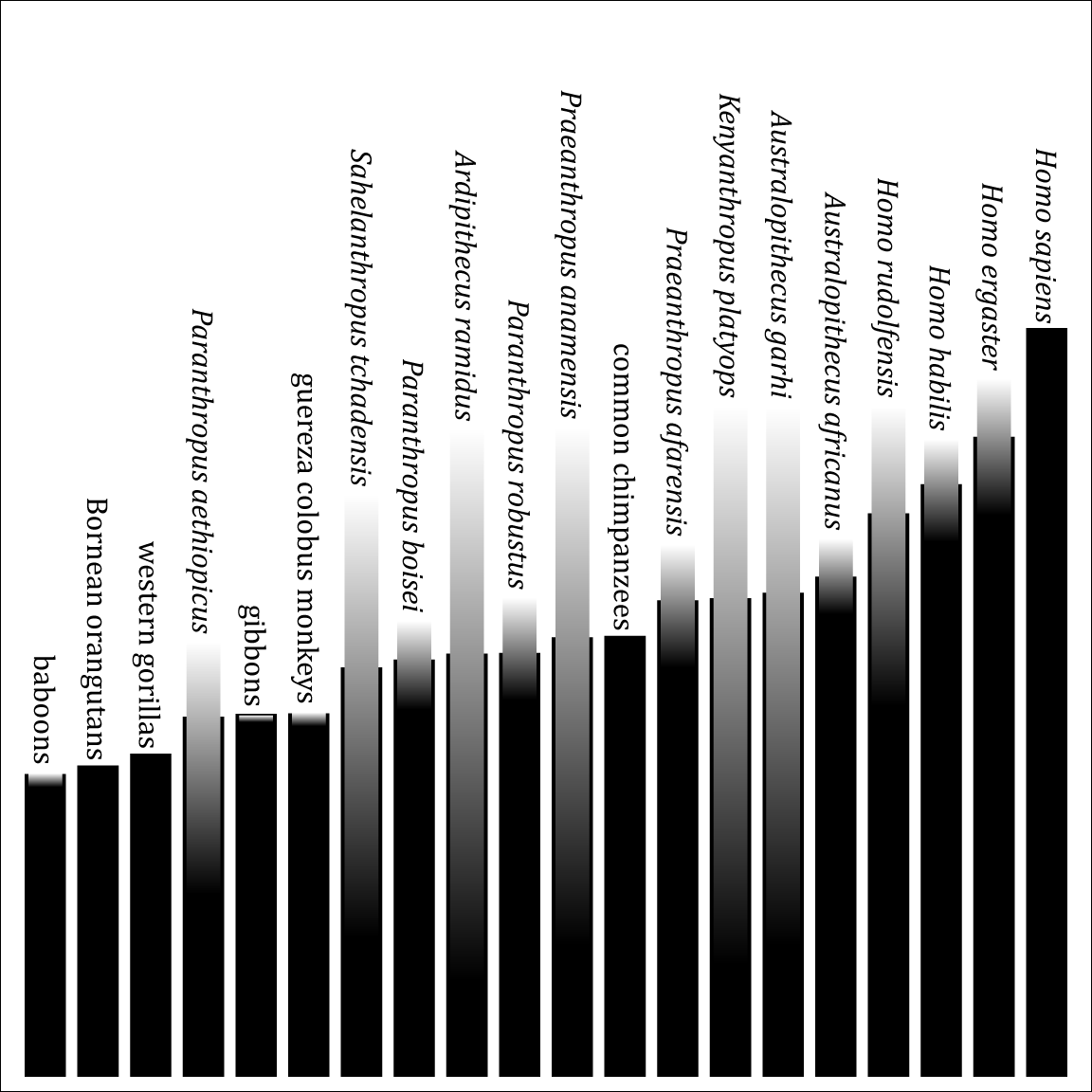
This chart represents all known hominid individuals (Hominidae = great apes, including humans and stem-humans) from the Messinian to the present, erring on the conservative side when the material is too poor to determine the exact number.

If you've been following this blog for a few years you may remember an earlier version of this. I've done a lot of refinement to the data since then. The earlier versions were dissatisfying to me because the horizontal axis was essentially arbitrary. For this version I used matrices from a phylogenetic analysis (Strait and Grine 2004, Table 3 and Appendix C) of craniodental characters to generate a distance matrix, and then inferred positions for other taxa based on phylogenetic proximity and containing clade. This is similar to the metric I used in this chart, except that it incorporates Appendix C, uses inference, and averages distance from humans against distance from [Bornean] orangutans. Don't be mistaken  this is still arbitrary. But it's a bit closer to something real.

Stray notes:
  • I'm pretty sure there are Pliocene stem-orangutans somewhere, right? Might have some work left to do on that data.
  • The dot with no taxon above "Australopithecus" is an indeterminate stem-human from Laetoli. It should probably go further left.
  • The Ardipithecus bubble includes the poorly-known "Australopithecus" praegens. (Although in some runs it moves outside  there's a random element to the plotting.)
  • The Holocene is barely visible up at the top. What a worthless epoch.
  • Homo floresiensis (hobbits) are far to the left of Homo sapiens because I placed them outside Clade(Homo erectus  Homo sapiens).
  • You may recall Lufengpithecus? wushanensis as "Wushan Man", as it was originally placed in Homo erectus. (Hey, it's just teeth.)
  • A couple of fossil chimpanzees, lots of fossil orangutans, but no fossil gorillas. :(
    • (Unless you count Chororapithecus, but that's pre-Messinian. Very pre-Messinian. Suspiciously pre-Messinian....)
  • Look at all that overlap between Homo, Paranthropus, and Australopithecus!
    • I have a feeling, though, that if I added another dimension, Paranthropus and Homo would jut out in opposite directions.
    • Reclassifying Australopithecus sediba as Homo sediba would also decrease the overlap. (Although its position is inferred  actually scoring it might do the same thing.)
    • It's frustrating that the type species of Australopithecus and Paranthropus are also just about the most similar species across the two genera.
  • Kenyanthropus and Praeanthropus have been provisionally sunk into Australopithecus.
  • Should we just sink Orrorin and Sahelanthropus into Ardipithecus? Why not?
  • My guess is that if I added postcranial characters, the stem-humans would all shift right (humanward). Oh, for a good matrix of postcranial characters....
Update
Oh yeah, and if you want a peek at the data, go here.

21 August 2012

Using Morphological Distance to Determine Genera

A genus is not an empirical entity. It's a bookkeeping convention, up to the personal whims of the taxonomist. And of course this leads to a huge mess.
Homo ergaster,
from PhyloPic

Depending on the taxonomist (and, for early forms, the phylogeny), the human total group includes anywhere from one genus (Homo) to ten (Ardipithecus, Australopithecus, Homo, Kenyanthropus, Orrorin, Paranthropus, Paraustralopithecus, Praeanthropus, Sahelanthropus, and Zinjanthropus  not even mentioning obsolete ones like Telanthropus and Pithecanthropus). We could try to clean up this mess by creating phylogenetic definitions and reinterpreting the genera as clades, except that all of the type species are thought by at least some researchers to be ancestral forms (with the exceptions of Homo sapiens, Paranthropus robustus, and Zinjanthropus boisei). For example, if Australopithecus is a clade that includes Australopithecus africanus, then it might also include Homo, and genera are not allowed to overlap under the ICZN.

After playing around with morphological distances based on Strait & Grine's (2004) character matrix, it occurred to me you could base genera on morphological distance. You have to make subjective decisions as to how many genera you want and which matrix to use, but the rest follows naturally. You just look at each species and see which valid type species it's closest to. Here's what I found:

If we use all of the above genera, then the taxonomy looks like this:
  • Ardipithecus
    • Ardipithecus anamensis (Not in Praeanthropus, despite sometimes being synonymized with afarensis! Although it should be noted that ramidus is much better known now than in 2004, so this may have changed.)
    • Ardipithecus ramidus
  • Australopithecus
    • Australopithecus africanus
  • Homo
    • Homo ergaster
    • Homo habilis (although it is closer to garhi than to sapiens!)
    • Homo sapiens
  • Kenyanthropus
    • Kenyanthropus garhi (!)
    • Kenyanthropus platyops
    • Kenyanthropus rudolfensis (although it is closer to ergaster and habilis than to platyops, it is still closer to platyops than to sapiens)
  • Orrorin
    • Orrorin tugenensis (not included in the study, but this is nomenclaturally where it would go unless found to be a synonym)
  • Paranthropus
    • Paranthropus robustus
  • Paraustralopithecus
    • Paraustralopithecus aethiopicus
  • Praeanthropus
    • Praeanthropus afarensis
  • Sahelanthropus
    • Sahelanthropus tchadensis
  • Zinjanthropus
    • Zinjanthropus boisei
Not included: species that are not types and were not included in the study, like Ardipithecus kadabba (scrappy craniodental remains), Australopithecus sediba (hadn't been discovered in 2004), Homo heidelbergensis (pretty close to sapiens anyway), etc.

It must be said that Zinjanthropus and Paraustralopithecus are not that commonly used. If we remove Paraustralopithecus, then aethiopicus predictably falls into Zinjanthropus. If we remove Zinjanthropus as well, then both aethiopicus and boisei predictably fall into Paranthropus.

Praeanthropus is also not that widely used. If we remove that as well, we get:
Praeanthropus afarensis,
from PhyloPic
  • Ardipithecus
    • Ardipithecus anamensis
    • Ardipithecus ramidus
  • Australopithecus
    • Australopithecus afarensis
    • Australopithecus africanus
  • Homo
    • Homo ergaster
    • Homo habilis
    • Homo sapiens
  • Kenyanthropus
    • Kenyanthropus garhi
    • Kenyanthropus platyops
    • Kenyanthropus rudolfensis
  • Orrorin
    • Orrorin tugenensis
  • Paranthropus
    • Paranthropus aethiopicus
    • Paranthropus boisei
    • Paranthropus robustus
  • Sahelanthropus
    • Sahelanthropus tchadensis
Kenyanthropus is a rather controversial genus. If we remove it, we get:
  • Ardipithecus
    • Ardipithecus anamensis
    • Ardipithecus garhi
    • Ardipithecus platyops
    • Ardipithecus ramidus
  • Australopithecus
    • Australopithecus afarensis
    • Australopithecus africanus
    • Australopithecus rudolfensis (still refuses to go with sapiens!)
  • Homo
    • Homo ergaster
    • Homo habilis
    • Homo sapiens
  • Orrorin
    • Orrorin tugenensis
  • Paranthropus
    • Paranthropus aethiopicus
    • Paranthropus boisei
    • Paranthropus robustus
  • Sahelanthropus
    • Sahelanthropus tchadensis
If we also remove Sahelanthropus, then tchadensis goes easily into Ardipithecus. I assume tugenensis would as well, if we removed Orrorin, but that wasn't included in the study since the craniodental material is so scant. If we remove Paranthropus, its species go very, very reluctantly into Australopithecus (by which I mean despite not being that close to africanus):
Sahelanthropus tchadensis,
from PhyloPic
  • Ardipithecus
    • Ardipithecus anamensis
    • Ardipithecus garhi
    • Ardipithecus platyops
    • Ardipithecus ramidus
    • Ardipithecus tchadensis
    • Ardipithecus tugenensis?
  • Australopithecus
    • Australopithecus aethiopicus
    • Australopithecus afarensis
    • Australopithecus africanus
    • Australopithecus boisei
    • Australopithecus robustus
    • Australopithecus rudolfensis
  • Homo
    • Homo ergaster
    • Homo habilis
    • Homo sapiens
Ardipithecus ramidus was originally named as Australopithecus ramidus. If we remove Ardipithecus, its species predictably end up in Australopithecus:
  • Australopithecus
    • Australopithecus anamensis
    • Australopithecus aethiopicus
    • Australopithecus afarensis
    • Australopithecus africanus
    • Australopithecus boisei
    • Australopithecus garhi
    • Australopithecus platyops
    • Australopithecus ramidus
    • Australopithecus robustus
    • Australopithecus rudolfensis
    • Australopithecus tchadensis
    • Australopithecus tugenensis?
  • Homo
    • Homo ergaster
    • Homo habilis
    • Homo sapiens
Now for the final cut. What happens when we remove Australopithecus?
Pan paniscus,
from PhyloPic
  • Gorilla
    • Gorilla aethiopicus (!!! although gorilla only beats sapiens by a hair)
    • Gorilla beringei
    • Gorilla garhi (!!!)
    • Gorilla gorilla
    • Gorilla tchadensis (admittedly, this was suggested by Senut and Pickford)
  • Homo
    • Homo africanus
    • Homo boisei
    • Homo ergaster
    • Homo habilis
    • Homo platyops
    • Homo robustus
    • Homo rudolfensis
  • Pan
    • Pan afarensis (!!)
    • Pan anamensis (!!)
    • Pan paniscus
    • Pan ramidus (!!)
    • Pan troglodytes
  • incertae sedis
    • Orrorin tugenensis
Yes, some of the stem-humans get pulled in with chimpanzees or gorillas! And there seems to be little rhyme or reason as to which go where. The splitting of the "robust australopithecines" is most bizarre (although, as noted, it only takes a tiny nudge to put aethiopicus in Homo with the others).

In summary:
  • This is just one matrix, only focusing on one area of the anatomy.
  • There are huge amounts of uncertainty with some of these taxa.
  • Even without the uncertainty, there is no objective way to measure morphological distance.
  • Even if there were, it might not be a good idea to use it to determine generic boundaries.
  • Generic boundaries are stupid, anyway.

Closest to Humans: The Skull & Tooth Version

Previously I posted a diagram showing how different various primates are from humans, based on soft tissue characters.  Here is a similar diagram, but using the craniodental characters from Strait & Grine's (2004) matrix. Unlike the soft-tissue diagram, this includes fossil taxa.


This black lines indicate the probable distance, as inferred from the phylogeny. The gradients show the actual range of uncertainty. (They'd also show polymorphism, but this matrix has none.) Ordering is according to probable distance—using the mean of the range of uncertainty yields slightly different results.

As in the soft-tissue diagram, chimpanzees are closer to humans than any other living primates are. But, oddly, gibbons and colobus monkeys are closer to humans than gorillas and orangutans! My guess is that this is because gorillas and orangutans are more derived from the ancestral catarrhine state than gibbons or colobus monkeys. (This probably also explains why the Paranthropus species, a.k.a. "robust australopithecines", are further than chimpanzees, although it is strange that the earliest one, P. aethiopicus, is furthest.)

To the right of chimpanzees is a very unsurprising pattern: "gracile australopithecines", then basal Homo species, then the large-brained Homo ergaster, and finally the huge-brained Homo sapiens.

You can also see how well-known the fossil crania are, ranging from the very well-known Australopithecus africanus to the crushed skull of Kenyanthropus platyops. Note that Ardipithecus ramidus is much better known now than when this study was done.

Again a disclaimer: this is not an objective measure of morphological similarity (there is no such thing), and it is definitely not a phylogenetic analysis (even if the data is taken from one).


References


  • Strait & Grine (2004). Inferring hominoid and early hominid phylogeny using craniodental characters: the role of fossil taxa. Journal of Human Evolution 47:399–452. doi:10.1016/j.jhevol.2004.08.008

17 August 2012

Refinement: Primate Anatomical Similarity

Earlier, I posted a chart showing how similar humans are to other primates (and other euarchontoglires),  as measured from Diogo & Wood's (2011) soft-tissue character matrix. A problem with the earlier version was that it doesn't reflect uncertainty in that matrix. (It also wouldn't show polymorphisms, although that matrix doesn't have any, anyway.) I've created a new version that shows the maximum and minimum possible distance, given the uncertainties in the matrix.


08 August 2012

How similar are we, anatomically, to other primates?

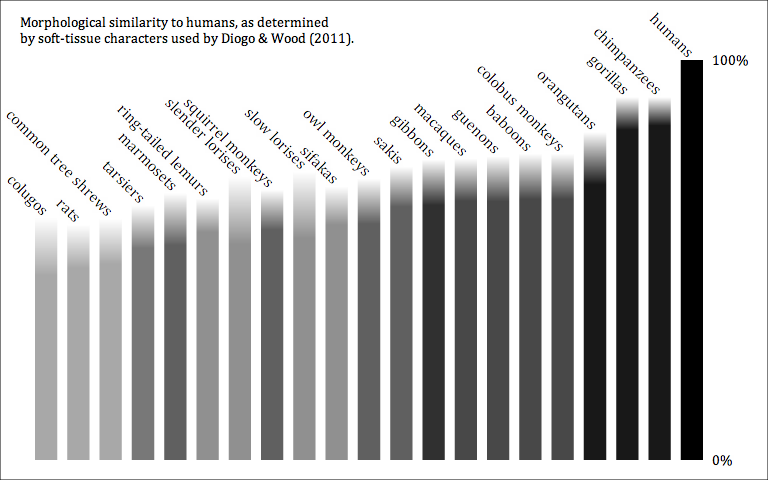
There is no objective way to measure anatomical similarity, but you can get a sense by converting character matrices into distance matrices. I've done this for the matrix used by Diogo & Wood (2011), which looked at soft tissue anatomy. Here is a bar chart showing how similar each taxon is to humans:


Dangit, 2011, not 2010. I'll fix it later.
Click for full size.
As you can see, the distances for great apes are well-marked and exactly what you'd expect based on phylogeny, but past that it gets a bit fuzzy. Moving outward from the great apes we get to Old World monkeys, then gibbons (from phylogeny you'd expect gibbons first, but the difference is so minor I'm sure it's meaningless), then a mixture of non-catarrhine primates, and finally non-primates.

This figure was generated using a JavaScript library I'm developing. I'll say more later, but rest assured it will be free and open source.

Expect to see some more stuff like this on A Three-Pound Monkey Brain soon.

References


  • Diogo & Wood (2011). Soft-tissue anatomy of the primates: phylogenetic analyses based on the muscles of the head, neck, pectoral region and upper limb, with notes on the evolution of these muscles. J. Anat. 219:273359. doi:10.1111/j.1469-7580.2011.01403.x

11 October 2011

Human Clades: A Look at a Complex Phylogeny

Most methods of phylogenetic analysis deal with simple trees. In these phylogenies, every taxonomic unit has a single direct ancestor (or "parent"). But we know that phylogeny is often more complex than this. Our own species is an excellent examplewhile we are all primarily descended from one population in Africa, different peoples around the globe have inherited smaller percentages of ancestry from preexisting populations.

A new study by Reich & al. looks in some detail at peoples who have inherited DNA from the Denisovans, a fossil group known from Siberia. Ancient DNA has been retrieved from these fossils, although unfortunately the fossils are otherwise too scant to tell us much about what Denisovans looked like (other than "humanlike").

Reich & al. posit a complex phylogeny wherein populations are often descended from multiple ancestral populations. Lets take a look at the clades posited in this study.


Operational Taxonomic Units

Reich & al. used the following nine populations, seven extant and two extinct, as operational taxonomic units.


Yoruba.An ethnicity from West Africa (Nigeria, Benin, Ghana, etc.)
(Photo by Marc Trip.)

Han.—The most populous Chinese ethnicity.
(Photo by Brian Yap.)

Mamanwa.—One of the "Lumad" ("indigenous") ethnicities of the southern Philippines.
(Photo by Richard Parker.)


Jehai.—One of the Orang Asli ("original people") groups of Malaysia.
Note: this photo is of a woman from a different Orang Asli tribe, the Batik.
(Photo by Wazari Wazir.)

Onge.—A group of Andaman Islanders, from the Bay of Bengal.
(Photo from The Andamanese, by George Weber.)

Australians.—The indigenous ("aboriginal") peoples of Australia.
(Photo by Rusty Stewart.)

Papuans.—The indigenous peoples of the New Guinean highlands.
(Photo owned by the Center for International Forestry Research.)
Neandertals.—An extinct group of robust near-human peoples from West Eurasia.
(Photo by myself, of a sculpture by John Gurche.)


Denisovans.—An extinct group of near-human peoples known from Siberia but thought to have had a wider range.
Note: The photo is of a sculpture of Homo heidelbergensis, thought to be the common ancestor of humans, Neandertals, and Denisovans. Denisovans may not have looked exactly like this.
(Photo by myself, of a sculpture by John Gurche.)


Phylogeny


Reich & al. postulated the simplest phylogeny that could possibly explain their data. (Note that the actuality is likely more complex than this, but it's a good starting point.) More recent groups are to the right, and the thickness of the lines indicates the percentage of DNA contributed from population to population.


My diagram, not theirs. Any inaccuracies are my own.
Free for reuse under Public Domain.


I've added a line for the Denisovans' mitochondrial (motherline) ancestor, even though it's not part of the paper's phylogeny. More on that as we start looking through the various clades.


For looking at the clades I'll use a different diagram that does not reflect percentage of ancestry, but simply shows direct descent as unweighted arcs connecting parent and child taxonomic units.


Phylogeny of human and near-human populations according to Reich & al. 2011.
Created using Names on Nodes.
Free for reuse under Public Domain.


15 September 2011

Soft Tissue Characters Supporting the Great Ape Clades

In my last post, I took a look at some morphological cladistic analyses of hominoids (apes) and tried to compile list of characters that supported the major clades: great apes, African great apes, and mangani (chimpanzees + humans). Unfortunately the studies I looked at only considered skeletal characters (and one of them only craniodental characters). Fortunately, a reader (Dartian) suggested some studies that look at soft tissue characters. I've just skimmed this paper:
  • GIBBS, S., COLLARD, M. & WOOD, B. (2002). Soft-tissue anatomy of the extant hominoids: a review and phylogenetic analysis. Journal of Anatomy 200:349. doi:10.1046/j.0021-8782.2001.00001.x
The authors compiled a matrix of 171 soft tissue characters and found strong support for the topology produced by earlier molecular studies (gibbons, (orangutans, (gorillas, (humans, chimpanzees)))). Below, I've compiled lists of character states that unambiguously support the major clades:

04 January 2011

Hybridizing Stem-Humans: Or, Is Everyone Right?

Analysis of mitochondrial DNA shows that the human matrilineage split from the Denisovan matrilineage around a million years ago. The nuclear genome shows a more recent split of humans (Homo sapiens) from both Denisovans (Homo sp. indet.) and Neandertals (Homo neanderthalensis) around 270–440 millennia ago. And yet some modern humans (Melanesians) appear to have inherited a small portion (4–6%) of nuclear DNA from Denisovans. This means that hominin populations can recombine even after being split for hundreds of thousands of years.


A "wholphin" (Tursiops truncatus × Pseudorca crassidens).
Photo by Mark Interrante.
 
Properly considered, this is not shocking at all. In other placental species, populations that have been split for far longer periods of time can hybridize. Look at "wholphins", hybrids between bottlenose dolphins (Tursiops truncatus) and false killer whales (Pseudorca crassidens). Those parent species have been split for around seven million years, longer even than the split between humans and chimpanzees!


Of course, humans can't (or at least don't) interbreed with chimpanzees, so the length of the split is not a perfect predictor of whether lineages can recombine. But it's interesting to consider how much lineage recombination might have occurred in stem-humans. The most divergent known lineages from our own are probably late Paranthropus (P. robustus and P. boisei). Our common ancestor with them is generally thought to be something like Australopithecus africanus, or perhaps Praeanthropus afarensis. Even opting for the older choice, this would make the length of their split from our putative contemporaneous ancestor, Homo habilis, only around a million years (roughly). That's not a terribly long split.


Did Homo habilis have multiple ancestors?
(Photo by Charles Roffey)
What this says to me is that there is no a priori reason to suppose that any two contemporary populations of hominin could not have interbred. Maybe Paranthropus aethiopicus interbred with early Homocould this explain Australopithecus garhi? Maybe the Denisovans themselves are Homo erectus × neanderthalensis. Maybe Homo floresiensis are pinheaded, pygmy descendants of Homo erectus and an unknown, pre-Homo lineage! (I'm not saying I necessarily support any of these ideas; I'm just throwing them out there.)


Also consider the debates over human ancestry in the field of paleoanthropology. It's a common observation that whenever someone finds a new stem-human (or stem-mangani) species, they declare it a human ancestor, while their rival colleagues pooh-pooh the finding and maintain that their own specimens are the true ancestors. (There are notable exceptions to this, of course, but it does seem to happen again and again.) But what if everyone is right? What if most of these fossil species are ancestral to us, but in varying proportions? I can't see any reason why this would be unimaginable.


A human with partial
Neandertal ancestry
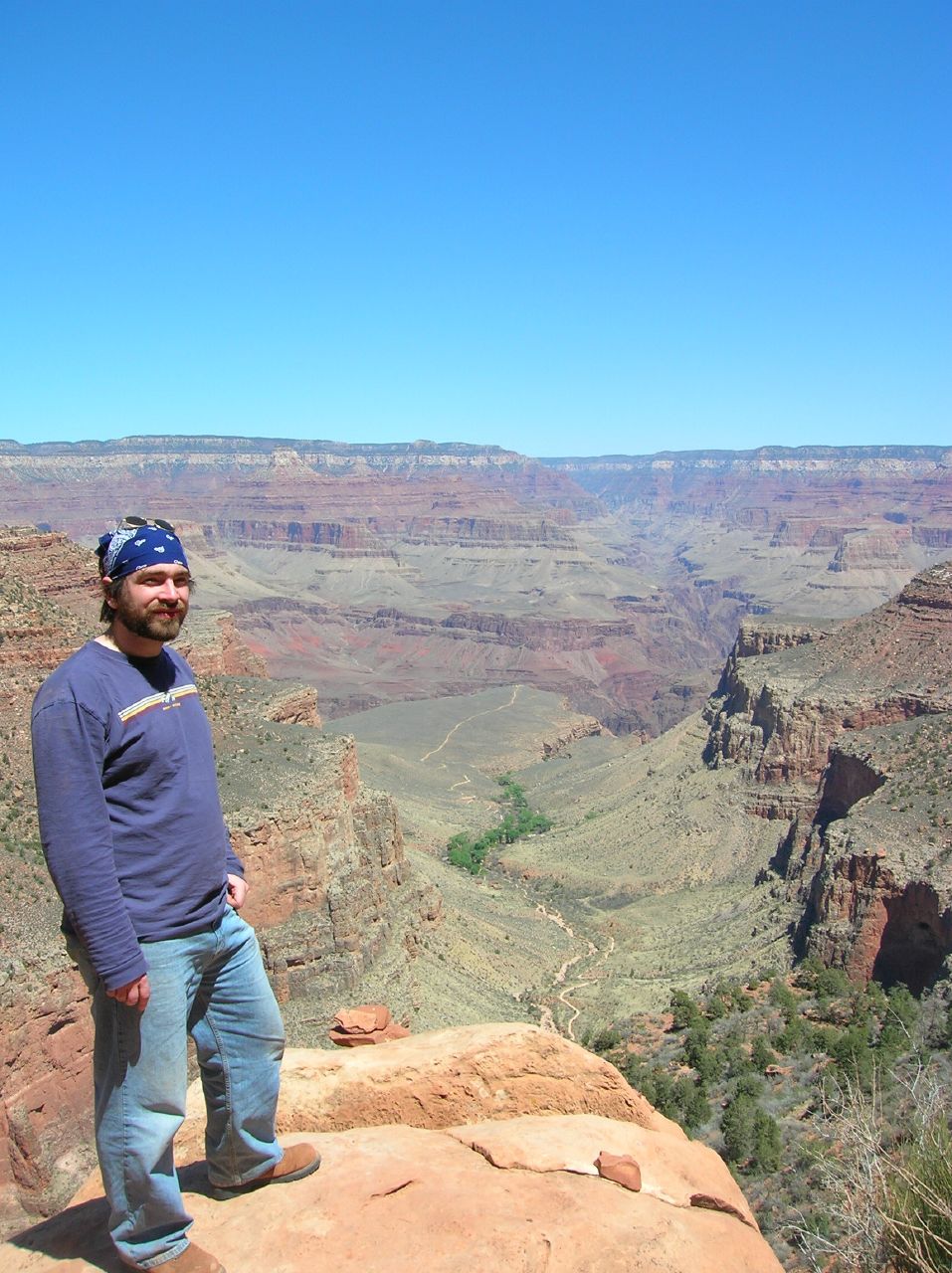
(blog's author).
Again, this is not an uncommon phenomenon in other placental species. Consider coyotes (Canis latrans)the eastern populations have partial ancestry from wolves (Canis lupus). Eastern lowland gorillas (Gorilla beringei graueri) may have partial ancestry from western gorillas (Gorilla gorilla). Our species is not unique in being partially hybridized.


So when people argue whether we are descended from Praeanthropus afarensis vs. Australopithecus africanus vs. Orrorin tugenensis vs. Kenyanthropus platyops—maybe everyone is right! At the very least, it seems to me that future discovery depends on allowing for significant amounts of admixture, and not blindly assuming simple bifurcation.


References

  • Ackermann & Bishop (2009). Morphological and molecular evidence reveals recent hybridization between gorilla taxa. Evolution 64(1):271–290. doi:10.1111/j.1558-5646.2009.00858.x
  • Green & al. (2010). A draft sequence of the Neandertal genome. Science 328:710722. doi:10.1126/science.1188021
  • Kays & al. (2009). Rapid adaptive evolution of northeastern coyotes via hybridization with wolves. Biol. Lett. 6:89–93. doi:10.1098/rsbl.2009.0575
  • Kim & al. (2009). Evolutionary charactterization of a highly repetitive sequence identified from the false killer whale (Pseudorca crassidens). Genes Genet. Sys. 84:185–189. doi:10.1266/ggs.84.18
  • Reich & al. (2010). Genetic history of an archaic hominin group from Denisova Cave in Siberia. Nature  468:1053–1060 doi:10.1038/nature09710
  • Xiong & al. (2009). Seven new dolphin mitochondrial genomes and a time-calibrated phylogeny of whales. BMC Evol. Biol. 9. doi:10.1186/1471-2148-9-20

23 December 2010

What is a human?

Find the human! Pretty easy, right? RIGHT??
It is obvious what is "human" and what is not if we just look at living organisms. There's a clear gap between us and our closest living relatives, the chimpanzees. No danger of mistaking one for the other.

But this clarity vanishes as soon as we look at the fossil record. There's a gradient of forms between us and things that are not clearly closer to us or chimpanzees (ArdipithecusOrrorinSahelanthropus). Which ones are "human" and which are not? Is Praeanthropus afarensis human? What about Homo habilis? Homo ergaster? Neandertals? Homo sapiens idaltu?
Find the human! Or is there more than one?
Or are they all human?


This issue crops up for all kinds of taxa. Much time has been spent arguing what is and is not e.g., avian, or mammalian. The issue is more common within vertebrates than many other taxa, since vertebrates have an especially good and well-studied fossil record. But it applies, in theory or practice, to every extant taxon.


I subscribe to the school of thought that names born from neontology (the study of extant organisms) are best restricted to the crown group (that is, to the living forms, their final common ancestor, and all descendants of that ancestor). Arguments for restricting common names to crown groups were first laid out by de Queiroz and Gauthier (1992). The primary reason for doing this is that it prevents unjustified inferences about stem groups (that is, the extinct taxa which are not part of the crown group, but are closer to it than to anything else extant). For example, we currently have no way of knowing whether the statement, "Within all mammalian species, mothers produce milk," is true if we include things like Docodon as mammals (or, as a few have done, even earlier things like Dimetrodon). However, if we restrict Mammalia to the last common ancestor of monotremes and therians (marsupials and placentals) and all descendants of that ancestor, then the statement unambiguously holds.


This system also gives us a very easy way to refer to any stem group: just add the prefix "stem-". Some examples:
  • stem-avians: Pterodactylus, Iguanodon, Diplodocus, Eoraptor, Coelophysis, Tyrannosaurus, Oviraptor, Velociraptor, ArchaeopteryxIchthyornis
  • stem-mammals: Casea, Dimetrodon, Moschops, Cynognathus, Docodon
  • stem-whales: Indohyus, Ambulocetus, Pakicetus, Basilosaurus, Dorudon
  • stem-humans: Ardipithecus(?), Praeanthropus, Australopithecus, Homo habilis, Homo ergaster
stem-humans
This is a nice, neat system. However, for humans, it gets a little sloppy the closer we get to the crown group.

For a long time, there was a debate in paleoanthropology as to how our species originated. We are distributed across the globe, so it's not immediately obvious where we are from. As the hominin fossil record gradually came to light during the 20th century, it became clearer that the earliest roots of the human total group were in Africa, since that's where the oldest remains are found. Everything before two million years ago is African, and only after that time period do we start to see remains in Eurasia, all of them belonging to the genus Homo. Remains in Australia and America don't occur until very late, and only modern humans appear in those regions.

But this leaves open the question of our own species' origin. Homo had spread all over the Old World by the time modern humans appeared, so we could have come from anywhere in Africa or Eurasia. Two major hypotheses were formed. The Out of Africa Hypothesis suggested that the ancestors of humans originated in Africa and then spread out over the globe, displacing all other populations of Homo: the Neandertals in West Eurasia, Peking Man in Asia, Java Man in Malaya, etc. The Multiregional Hypothesis, on the other hand, suggested that modern human races evolved more or less in their current areas: Negroids were descended from Rhodesian Man, Caucasoids from Neandertal Man, and Mongoloids from Peking Man.

These hypotheses competed with each other until the advent of genetic analysis. When scientists were finally able to study the mitochondrial genome, which is copied from mother to child, they found that all living humans shared a relatively recent matrilineal ancestor, much more recent than the splits between Rhodesian, Neandertal, and Peking fossils. Furthermore, the matrilineal family tree strongly points to an ancestor in Africa, where the most divergence is found. Study of the Y chromosome, which is copied from father to son, indicated an even more recent patrilineal ancestor, also African. The case seemed closed. Out of Africa had won.

The case seemed further bolstered when the Neandertal mitochondrial genome was recovered. It revealed a signature which clearly placed it outside the modern human group (Teschler-Nicola & al. 2006). Earlier this year, mitochondrial DNA was also retrieved from an indeterminate fossil from Denisova, Siberia, indicating that it represented a matrilineage even further out, preceding the human-Neandertal split (Krause & al. 2010).

This would give us a pretty nice, clean series of splits. And it would mean that Neandertals, Denisovans, etc. are stem-humans.

But there is more to ancestry than just the matrilineage and the patrilineage. Most of our ancestral lineages include members of both sexes (think of your mother's father and your father's mother). The matrilineage and patrilineage are the only ones that can be studied with clarity, since all other chromosomes undergo a shuffling process. But those other lineages exist nonetheless.

Only very recently has evidence come to light which challenges Out of Africa, at least in its strong form. Earlier this year, a study suggested that all humans except for Sub-Saharan Africans have inherited 1–4% of their DNA from Neandertal ancestors (Green & al. 2010). And just yesterday, a new analysis of Denisovan nuclear DNA showed that Melanesians have inherited 46% of their DNA from Denisovans. This nuclear DNA seems to originate from an ancestor close to the human-Neandertal split, but somewhat on the Neandertal side.

Long story short, the picture has gotten a lot more complicated. It's no longer, "Out of Africa, yes, Multiregional, no." Now it's, "Out of Africa, mostly; Multiregional, somewhat."

So what does this mean for the term "human"? Are Neandertals and Denisovans human? After all, they seem to be ancestral to some, but not all, modern human populations.

Well, they can only belong to the crown clade if they are the final common ancestor of all living humans, or descended from it. Neither of these criteria appear to hold. So, for now, I would still say that they are not human, only very close to human. (Note that this does not mean that people descended, in part, from Neandertals and/or Denisovans are somehow "less human" than those with pure African ancestry. The African ancestors are also not humans but stem-humans under this usage. This usage is discrete; you're either human or you aren't.)

Still, at this level of resolution, we start to see a problem with the crown clade usage. What is the final common ancestor? Many would assume it to be the last-occurring common ancestor, but this is problematic, and not just because that ancestor probably lived within recorded history (making, e.g., the Sumerians inhuman!). When I say "final" I'm really referring to something a bit more complexthe maximal members of a predecessor union. (More discussion here.) But determining what that is, exactly, requires better datasets than we have.

I still think it's a good convention, and if its application is a bit vague, so be itour knowledge is a bit vague. For now I would say that humans are a clade of large, gracile hominins with high-vaulted crania that emerged roughly 150,000 years ago in Africa, and then spread out. They are descended from not one but at least three major populations of stem-human. One of these, the African population (idaltu, helmei, etc.), forms the majority of the ancestry, up to 100% in some populations. The others, Neandertals and Denisovans, only form a small part of the ancestry of some humans.

I feel this convention is useful because it prevent unjustified inferences. For example, we know that all living human populations have languages with highly complex grammar. We really don't know whether Neandertals and Denisovans had such languages, or whether the immediate African predecessors of humans did, for that matter. So it's good to be able to categorize them as stem-humans, because it reminds us that we don't have as much data available on them as we do for the crown group. We have to be more clever in figuring these things out.

And if we ever cloned a Neandertal? Well, ask me again once that happens.

References
  • de Queiroz & Gauthier (1992). Phylogenetic taxonomy. Annual Review of Ecology and Systematics 23:449480. [PDF]
  • Green & al. (2010). A draft sequence of the Neandertal genome. Science 328:710722. doi:10.1126/science.1188021
  • Krause & al. (2010). The complete mitochondrial DNA genome of an unknown hominin from southern Siberia. Nature 464(7290):894–897. doi:10.1038/nature08976
  • Reich & al. (2010). Genetic history of an archaic hominin group from Denisova Cave in Siberia. Nature 468:1053–1060 doi:10.1038/nature09710
  • Teschler-Nicola & al. (2006). No evidence of Neandertal mtDNA contribution to early modern humans. Pages 491503 iEarly Modern Humans at the Moravian Gate. Springer Vienna.  doi:10.1007/978-3-211-49294-9_17

26 July 2010

3D Visualization of the Fossil Distribution of the Human-Chimpanzee Total Clade

What it says.
Click on the image to open the visualization.
I've been compiling data on "pan-mangani" fossils. This is my first March of Man toolshop post in a while: a 3D visualization of that data, where the horizontal axis is longitude, the vertical axis is latitude, and depth (the z-axis) is age. The "blobs" each represent a fossilized individual, and you can mouse over them to see what their taxon is.

Some data is missing, notably a lot of entries for our own species. Other data needs to be refined—some of the better-known species (ahem, Neandertals) are big clouds that need to be tied down to specific sites. Also, I obviously need to do more work on that present-day distribution map. But it's a decent start.


Fun things to do:

  • See if you can find the oldest individual (the lone specimen of Sahelanthropus tchadensis).
  • Try to find its Chadian compatriots.
  • Find the earliest non-African individuals (hint: East Europe and the Malayan Archipelago).
  • Wonder what the heck that thing in India is.
  • Look for the single cluster of extinct chimpanzees (Pan sp.).
  • Find the three subspecies of Homo sapiens other than our own. (Note: these may not be distinct from each other—I just prefer to err on the side of splitting for projects like these. Easier to revise later.)
  • Marvel at how easy it is to become sympathetic to multiregionalism when you just view the distribution data without any morphological context and ignore the fact that not all regions are good for preservation.
  • Wonder how people can possibly believe in baraminology in the face of such ample evidence. (Adding morphological data to this would help a lot—there really aren't any good "cutoff" points for our lineage.)
UPDATE:

Better version here.

28 May 2010

gautengensis in the sediba phylogeny

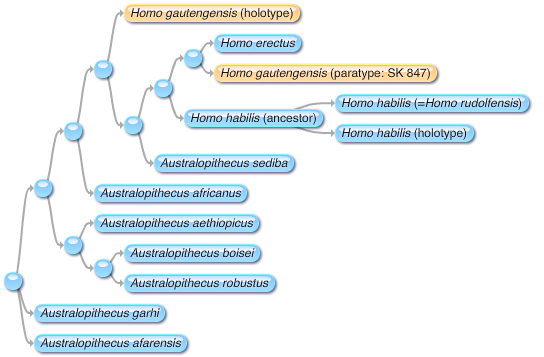
Here's the phylogeny/taxonomy from the Australopithecus sediba paper overlaid with the taxonomy from the Homo gautengensis paper:


(click to enlarge)

I've highlighted the taxonomic units that Curnoe referred to Homo gautengensis. Note that, by Berger & al.'s phylogeny, Homo gautengensis is polyphyletic. Each of those units represents a single specimen, so this could potentially be explained by individual variation, age differences, sexual dimorphism, etc. Or the new species is overextendedI'm not really qualified to judge.

Note also that Homo is polyphyletic in this phylogeny. One way to fix this is to move sediba into Homo.