13 February 2012

Half a Thousand Silhouettes

Last night PhyloPic reached 500 images! Here's the 500th, a Siberian tiger (Panthera tigris altaicus) by Steven Traver:


Steven submitted 71 silhouettes in the past week! (All vector, too.) I'd like to take a moment to recognize all the people who have submitted silhouettes numbering in the double digits:

26 January 2012

PhyloPic Is Back!

Last year, I launched a project called PhyloPic. The goal of this project was to create an open database of freely reuseable silhouette images of organisms. Furthermore, it featured a phylogenetic taxonomy so that, if a taxon wasn't illustrated, an approximation could be found.

I launched it as a "public alpha", meaning that it wasn't complete and still had some bugs. The year turned out to be very busy for me: an awful thing happened, and a wonderful thing happened. And I didn't really have time to push PhyloPic to the next level.

Unfortunately, I hadn't built it well enough in the first place. The architecture was not optimized, and the site became extremely slow and buggy. I took it offline, hoping to release a new version in short order, but it turned out to need a lot more work than I first thought.

Happily, it is now ready again!

16 January 2012

In Anticipation: The Evolution of the Raven, in Silhouettes

Any day now there will be a relaunch of a certain project I launched last year. (Just working through some technical details.) In anticipation of that, here's the evolutionary history of the Common Raven (Corvus corax), illustrated with silhouettes:

click to enlarge

A Proposal to Amend the PhyloCode


The draft PhyloCode has been in a pretty stable form for a while. But recently, there has been a proposal to drastically change how it handles species. You can read the proposal here: 


The first paragraph:

The overarching goal of this proposal is to remove all mention of "species" from the  PhyloCode. Detailed justifications for this goal are given in a supporting paper (Cellinese, Baum, and Mishler, in review); here we present a summary of the main arguments, along with specific proposals for change.

Before I weigh in on this, I'm curious as to what other people think. Please comment below, or send comments to David Marjanović, the Secretary of the Committee on Phylogenetic Nomenclature.

UPDATE:
If anyone would like a Microsoft Word version of this document, just ask.

ANOTHER UPDATE:
I have weighed in.

19 December 2011

Season's Greetings

Season's Greetings 2011

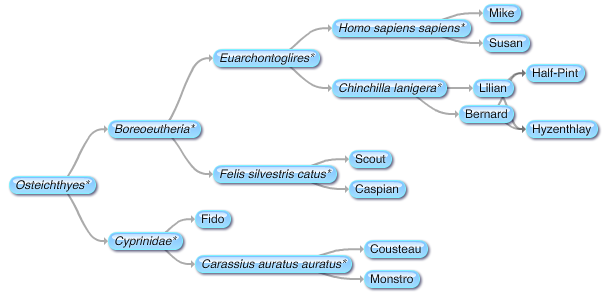
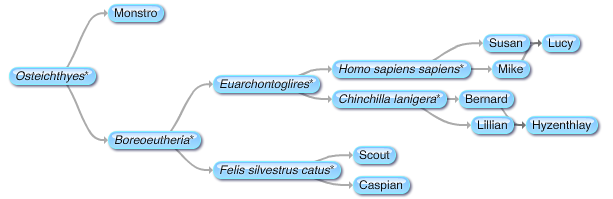
If you look at last year's Yule greeting, you'll note that we have lost a few at the Keesey-Havens household. The mighty Monstro now swims alone in his aquarium, his fellow goldfish Cousteau and his pet minnow Fido having passed away. Young Half-Pint died rather unexpectedly, leaving his chinchilla family in mourning (father Bernard, mother Lillian, sister Hyzenthlay). (I might be posting on him again, though....)

The family tree, as of Yuletide 2010.

But, in brighter news, we have a new addition! Lucy, the little human pictured above with our Christmas tree. And so it comes time to sadly trim but joyfully decorate our household's phylogenetic tree:

Updated for 2011.


EDIT: Whoops, misspelled "silvestris" in the 2011 version.

16 November 2011

What Is and Is Not a Stem Group

In recent years, I've noticed a trend: the prefix "stem-" is becoming more and more popular for stem groups. For those who don't know what a "stem group" is:

  • A crown group is the last common ancestor or two or more extant taxa, and all descendants thereof.
  • A total group is the first ancestor of a crown group that is not also ancestral to any other extant taxa, and all descendants thereof.
  • A stem group is a total group minus its crown group. (Which means, of course, that a total group is a crown group plus its stem group.)
Or, to put it more simply, an extinct organism is a stem-X if it does not belong to X, but it shares more ancestry with X than with any extant organisms outside of X. Real-life examples:

Velociraptor mongoliensis, a stem-avian.
Illustration by myself (Mike Keesey).
  • Stem-mammals: Dimetrodon, Moschops, Cynognathus, Castorocauda.
  • Stem-avians: Marasuchus, Psittacosaurus, Plateosaurus, Tyrannosaurus, Velociraptor, Archaeopteryx, Hesperornis.
  • Stem-humans: Ardipithecus(?), Australopithecus, Paranthropus, Homo habilis, Homo erectus.
  • Stem-cetaceans: Ambulocetus, Pakicetus, Maiacetus, Basilosaurus.
  • Stem-felines: Proailurus, Smilodon.
  • Stem-pterygotes Stem-neopterans: Dictyoneura, Lithomantis.
This is a great convention. It's consistently useful in every area of the Tree of Life. It's concise. It communicates instantly the general area we're talking about, and sets us up to make proper phylogenetic inferences (when the fossil data is lacking).

So I'm glad this trend is becoming more popular. Unfortunately, I've also noticed another trend: rampant misuse!

Case in point:
  • CABREIRA & al. (2011). New stem-sauropodomorph (Dinosauria, Saurischia) from the Triassic of Brazil. Naturwissenschaften (online early). doi:10.1007/s00114-011-0858-0
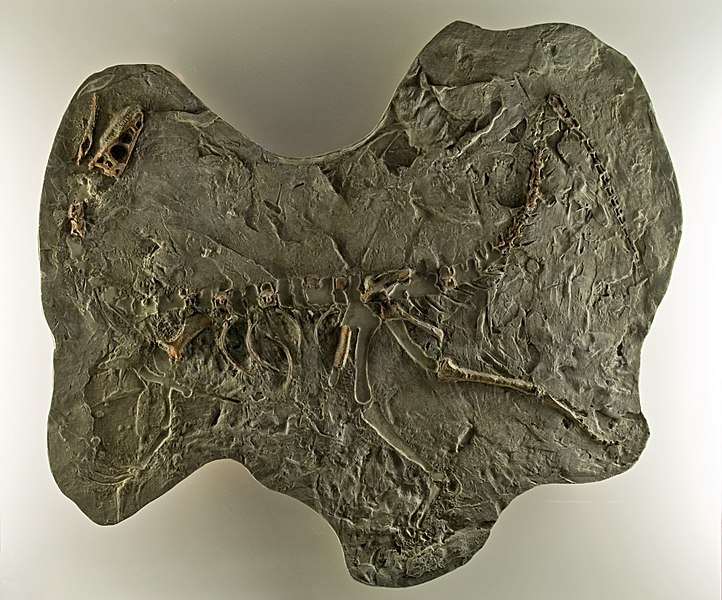
This looks to be an excellent paper on a very interesting find, so it's unfortunate that there's a glaring error in the title, but there it is: "stem-sauropodomorph". There is no such thing, because Sauropodomorpha is not a crown group. It doesn't even include a crown group (sadly—it'd be very cool if it did). Rather, all sauropodomorphs are part of the avian stem group.

Panphagia protos, a stem-avian
(not a "stem-sauropodomorph").
Photo by Eva K.
Used under the GFDL.
I see a lot of people making this mistake. I think what's happening is that they're using the basic concept of a stem group, but replacing "total group" with "some large clade" and "crown group" with "an interesting subclade". In this case, Sauropodomorpha is "some large clade" and Sauropoda is "an interesting subclade". (And in that case, the usage is even wronger, because it should at least be "stem-sauropod".)

This misuse is unfortunate because it is subjective, while the proper usage is objective. One could make the argument that the real "interesting subclade" of Sauropodomorpha is Titanosauria, or Neosauropoda, or whatever, and then the terminology would mean something very different. By contrast, e.g., "stem-crocodylian" very clearly indicates a particular paraphyletic group.

So, please, people, use the "stem-" prefix, but use it correctly!

04 November 2011

Lucy Gwyn Havens

Last Saturday our first child was born: a daughter, Lucy Gwyn Havens.

Lucy

We've made our own contribution to the phylogenetic tree!


Lucy.—There are many famous Lucys. Here's one relevant to the blog:


And of course, that one is named after this one:

Lucy in the Sky with Diamonds
by Julian Lennon
Gwyn.—Gwyn is an old Welsh family name on my side. More recently it was spelled "Guinn", but we decided to use the older spelling.

Havens.—You'll notice her surname is from her mother, not me. We decided early on that boys would be Keeseys and girls would be Havenses. If this becomes a tradition, it would link patrilineal names to the Y chromosome (something the dominant English system already does) and matrilineal names to the mitochondrial chromosome (a feature sorely lacking in the English system).


We love you, li'l Lulu!