A new stem-human species, Australopithecus sediba Berger et al. 2010, has just been announced. The paper's supplementary information contains the results of a cladistic analysis of stem-humans. For fun, I thought I'd plug the most parsimonious tree into the in-development version of Names on Nodes:
Stw 53 and SK 847 are specimens that are not readily assignable to named species. (SK 847 might be Homo ergaster). Our own species, sapiens, is presumably descended from the SK 847-erectus node.
The analysis finds sediba as a sister taxon to Homo (which includes habilis, rudolfensis, SK 847, and erectus), and possibly ancestral to it. Which begs the question, why not place it in Homo? If this hypothesis is correct, it shares more ancestry with the type species of Homo (sapiens) than it does with the type species of Australopithecus (africanus). Even Stw 53, which is here placed outside the sediba-Homo clade, has been attributed to Homo in the past.
08 April 2010
Viewing Phylogenies at Different Graph Resolution
Although I've been primarily reining in features on the next version of Names on Nodes, there was a new feature I couldn't resist adding. I think it's coming along pretty well.
A common problem with working with phylogenies is that many of them are gigantic, far too big to view all at once. As an example, consider Figure 1 from Beck et al. (2006). It models a hypothesis about placental mammal phylogeny, at an arbitrary resolution ("family-level"). Here's how the current version of Names on Nodes renders it:
When you look at it "zoomed out", it's almost impossible to know what's going on. When you look at it full size, you can see various local areas, but you lose a sense of what's going on with the larger image. Note that I've highlighted our own species' twig on the tree (Hominidae, the great ape clade) in yellow.
Earlier I used the term "resolution" to refer to the size of the graph's nodes. We can refer to a graph with very small nodes (e.g., each node representing an individual organism) as being "fine" and a graph with very large nodes (e.g., "class-level") as being "coarse". Thinking about the problem from this angle, I had the idea to create a control for coarsening or refining the viewed graph.
I implemented a simple graph-coarsening algorithm*, and then created an algorithm for picking the best name for the new, coarser graph's nodes. And here is the phylogeny at near-maximum coarseness:
This is placental phylogeny boiled down to its basics: rodents, laurasiatheres, and a bunch of other junk (including us). The node labelled "Placentalia*" contains the placental ancestor but not all descendants—it lacks an unnamed clade included most non-afrothere placentals. The unnamed greenish node includes all members of that unnamed clade except for rodents and laurasiatheres. (This happens to include Hominidae, which is why it has that greenish color.)
Let's refine it one step:
We're starting to get a better idea of the hypothesis. Finer:
Now we can see the basal split between afrotheres and other placentals, as well as developing complexity in Rodentia and Laurasiatheria. Finer:
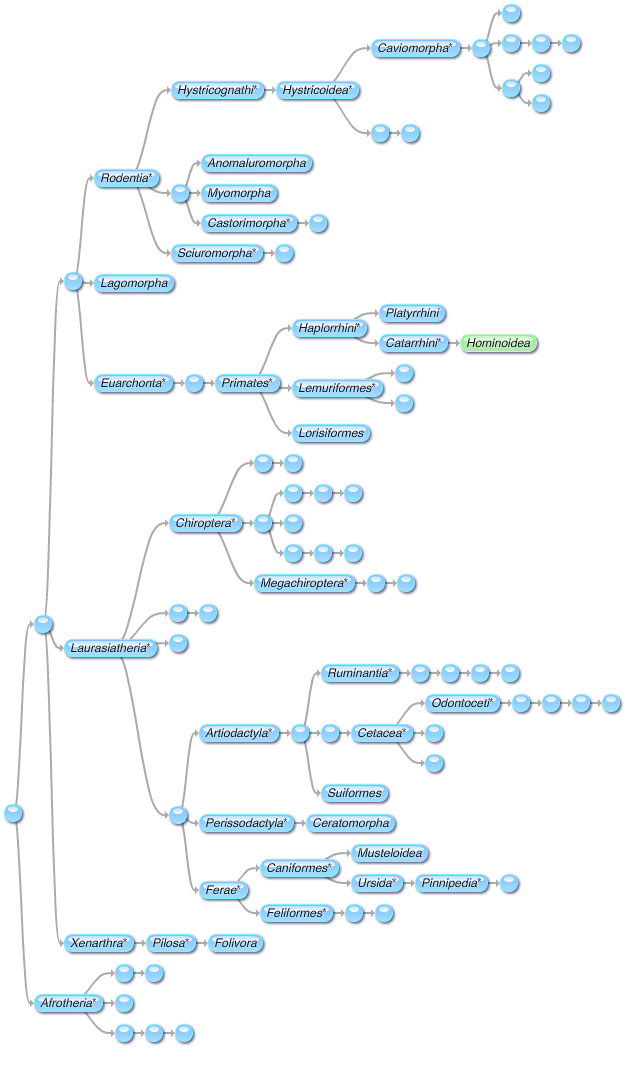
Getting a little bit on the big side, now, but we can see more details. There are a lot of unnamed clades within Hystricoidea and Chiroptera—we can see that those clades are diverse, although we can't see details. Finer:
This has about 2/5 as many nodes as the base graph. It's a bit large, but still much easier to view than the base graph. Many important details are visible (e.g., the platyrrhine-catarrhine split), while others are just suggested (e.g., lots of diversity in Caviomorpha).
Obviously this works best if lots of clades have been named. I think it'll be a useful for boiling a phylogeny down to an appropriate level: coarser for quick overviews, finer for in-depth discussion.
* Basic summary of the coarsening algorithm:
- Look through all nodes that have children, and find the ones whose children are all terminal (sinks).
- Merge each of those nodes with their children to create a "supernode".
- Merge all overlapping supernodes. (This is important for graphs where nodes may have multiple ancestors, although it doesn't come into play in this example.)
- Remove the supernodes from the graph and repeat from step 1. Keep going until no nodes are left.
- Add the supernodes to a new graph. A supernode is ancestral to another supernode if any of its subnodes are ancestral to any of the other supernode's subnodes.
Labels:
charts,
clade,
Flash,
Flex,
mammalia,
mathematics,
Names on Nodes,
nomenclature,
phylogeny,
placentalia,
web applications
05 April 2010
Sketch of a Phylogenetic Query Language
Names on Nodes uses MathML for two primary purposes:
This is a plain-text format loosely inspired by mathematical notation, the C language, etc. Using it, the above query becomes:
This is still in very early stages, so I thought I'd post it to get some feedback.
Here are a few of the simpler clade definition examples:
- Delineating phylogenetic hypotheses (as directed, acyclic graphs).
- Associating identifiers with definitions.
Homo sapiens, 2) a group called extant for all extant taxonomic units, and 3) a group called Kenya for all Kenyan taxonomic units, that query might look like this:<apply xmlns="http://www.w3.org/1998/Math/MathML">
<intersect/>
<ci>Kenya</ci>
<apply>
<setdiff/>
<apply>
<csymbol definitionURL="http://namesonnodes.org/ns/math/2009#def-Total"/>
<ci>Homo sapiens</ci>
<ci>extant</ci>
</apply>
<ci>Homo sapiens</ci>
</apply>
</apply>MathML is great for being flexible and extensible enough to cover concepts like this. But ... it's also really verbose. This is fine for my purposes so far, but it may be cumbersome for other purposes. So I've been playing around with a more succinct way to write these expressions. Today I tossed up some rough ideas here:This is a plain-text format loosely inspired by mathematical notation, the C language, etc. Using it, the above query becomes:
"Kenya" & (total("Homo sapiens", "extant") - "Homo sapiens")...which is quite a bit shorter.This is still in very early stages, so I thought I'd post it to get some feedback.
Here are a few of the simpler clade definition examples:
"Aves" := clade("Struthio camelus" | "Tetrao major" |
"Vultur gryphus").
"Saurischia" := clade("Megalosaurus bucklandii" <-
"Iguanodon bernissartensis").
"Avialae" := clade("wings used for powered flight" @
"Vultur gryphus").
Labels:
definition,
Names on Nodes,
phylogeny,
querying
02 April 2010
Names on Nodes: MathML Definitions (Version 1.2)
After the epiphany that Names on Nodes did not have to be associated with a database, I set to work creating a "standalone" version of the application. Progress has been pretty good, and if you are interested in the details (or collaborating), you can check the project out at its new home on Bitbucket (which also houses the related project, ASMathema).
I've just updated the Names on Nodes website based on these revisions to the project, most notably the MathML Definitions document. Most of the changes have actually been removals: no more mentions of rank-based taxonomy (which may be covered in future versions but not in this one), qualified names as taxonomic identifiers (no longer a necessary feature), etc. So if you didn't read it before because it was too long and dense ... well, it's still pretty long and dense, actually. But less so!
I've also added an example MathML document as a supplement. This document:
I've just updated the Names on Nodes website based on these revisions to the project, most notably the MathML Definitions document. Most of the changes have actually been removals: no more mentions of rank-based taxonomy (which may be covered in future versions but not in this one), qualified names as taxonomic identifiers (no longer a necessary feature), etc. So if you didn't read it before because it was too long and dense ... well, it's still pretty long and dense, actually. But less so!
I've also added an example MathML document as a supplement. This document:
- Defines a phylogenetic context (the same one used in the MathML Definitions examples), arranging taxonomic units as vertices in a directed, acyclic graph.
- Defines sets based on characters ("wings used for powered flight" and "extant")
- Refers a specimen (YPM-VP 1450) to a taxonomic unit (Ichthyornis).
- Equates several species names as synonyms.
- Defines some hybrid formulas as referring to specific taxonomic units.
- Defines a number of clade names.
Labels:
definition,
mathematics,
MathML,
Names on Nodes,
nomenclature,
phylogeny,
RIAs,
taxonomy,
web applications,
XML
28 March 2010
05 March 2010
Names on Nodes: Cutting Out the Fat
While pondering the headaches of homonymy recently, I started to ask myself, What am I doing with my life? Why am I worrying about this?
Seriously, though. I've been working on Names on Nodes on and off for about three years, and I still haven't launched it. And it's because I've been so focused on getting things like this right. (Well, that and having a day job.)
But things like this aren't part of the core functionality. The core functionality is the automated evaluation of phylogenetic definitions (encoded as MathML) within the context of phylogenetic hypotheses (modeled as directed, acyclic graphs). That part of it's been done for quite a while. So why am I wasting time on the rest?
By cutting out the entire database portion of the project, I could actually have something launched this year. Sure, it'd be nice to have a repository of taxonomic names, definitions, authorities, etc. But it's not necessary. It's phase II, not phase I. In fact, by the time I'm ready for a phase II, there will almost certainly be other services out there that already perform those things.
So, here on out, I'm going to be focusing on getting a lean, mean version of Names on Nodes up. Here's a quick summary of what you'll be able to do with it:
Seriously, though. I've been working on Names on Nodes on and off for about three years, and I still haven't launched it. And it's because I've been so focused on getting things like this right. (Well, that and having a day job.)
But things like this aren't part of the core functionality. The core functionality is the automated evaluation of phylogenetic definitions (encoded as MathML) within the context of phylogenetic hypotheses (modeled as directed, acyclic graphs). That part of it's been done for quite a while. So why am I wasting time on the rest?
By cutting out the entire database portion of the project, I could actually have something launched this year. Sure, it'd be nice to have a repository of taxonomic names, definitions, authorities, etc. But it's not necessary. It's phase II, not phase I. In fact, by the time I'm ready for a phase II, there will almost certainly be other services out there that already perform those things.
So, here on out, I'm going to be focusing on getting a lean, mean version of Names on Nodes up. Here's a quick summary of what you'll be able to do with it:
- Open bioinformatics files (NEXUS to start with, other formats like nexml going forward).
- View the phylogenies in a pretty graphical interface.
- Merge phylogenies.
- Tweak phylogenies (adding or removing parent-child relations, adding or removing taxonomic units, equating taxonomic units, etc.).
- Formulate phylogenetic definitions using a spiffy interface.
- Apply these definitions to the phylogeny.
- Save your work as MathML files.
Labels:
databases,
definition,
MathML,
Names on Nodes,
nomenclature,
phylogeny,
RIAs,
web applications
01 March 2010
The Great PhyloCode Land Run
Sometime in the near future, the PhyloCode will be enacted. For this to happen, two things need to happen concurrently:
1. The registration database (called "RegNum") must be completed and opened to the public. This is necessary because the PhyloCode requires all names to be registered electronically.
2. Phylonyms: a Companion to the PhyloCode must be published. This is a multi-authored volume that will include the earliest definitions under the PhyloCode.
Which names will be defined in Phylonyms? The original goal was to cover the most historically important names (what Alain Dubois calls "sozonyms"). However, proponents of phylogenetic nomenclature tend to be clustered in several fields (most notably vascular plant botany and vertebrate zoology—note that the code's authorship reflects this). This means certain parts of the Tree of Life (e.g., entomology) will unfortunately be underrepresented, due to lack of interest in those fields. (The alternative, having non-specialists define such names in Phylonyms, does not bear consideration.) So Phylonyms will be less about providing coverage and more about providing sturdy, well-reasoned definitions that can serve as examples.
What about all the names that it omits? What will happen to those once the PhyloCode is enacted? That will be interesting to see.
One thing I could envision is a sort of "land run". I picture it working this way. Let's consider a field, say, anthropology, where phylogenetic nomenclature has not taken much of a hold. Currently there is debate about how to use some taxonomic names related to the field. Some workers like to use the familial name "Hominidae" to refer to a large taxon, including humans and great apes. Others prefer to restrict it to the human total clade (i.e., humans and everything closer to them than to other extant taxa). Similarly, some workers use the generic name "Homo" in a broad sense to include short, small-brained species like Homo habilis, while others prefer to restrict it to the tall, large-brained clade (relegating H. habilis to another genus, e.g., Australopithecus).
Let's say there's a researcher out there named Dr. Statler, who prefers a strict usage for "Hominidae" and a broad use for "Homo". But his colleague, Dr. Waldorf, prefers a broad usage for "Hominidae". Dr. Waldorf isn't really that interested in phylogenetic nomenclature, but when he notes that "Hominidae" is not in the registration database, he sees an opportunity. He writes a quick paper defining "Hominidae" as a node-based clade: "The clade originating with the last common ancestor of humans (Homo sapiens Linnaeus 1758), Bornean orangutans (Pongo pygmaeus Linnaeus 1760), common chimpanzees (Pan troglodytes Oken 1816, originally Simia troglodytes Blumenbach 1775), and western gorillas (Gorilla gorilla Geoffroy 1852, originally Troglodytes gorilla Savage 1847)."
Dr. Statler is, of course, outraged. Not that he cares that much about phylogenetic nomenclature, but what if anthropologists do start using it? What if someone ruins another taxonomic name? His colleagues Drs. Honeydew and Beaker prefer a strict definition of "Homo"—what if they author a paper cementing that definition under the PhyloCode?
This cannot come to pass! Dr. Statler does some reading on the code and decides that a branch-based definition would work nicely for his broader usage. He defines "Homo" as, "The clade consisting of Homo sapiens Linnaeus 1758 and all organisms that share a more recent common ancestor with H. sapiens than with Australopithecus africanus Dart 1925, Paranthropus robustus Broom 1938, Zinjanthropus boisei Leakey 1959, or Australopithecus afarensis Johanson & White 1978." This sets off another anthropologist, and soon all sorts of anthropological/primatological names are being defined under the PhyloCode, as workers struggle to assert their usages.
This is not an ideal situation. It would be much nicer if a group of anthropologists were to come together, discuss the matters rationally, and arrive at an agreement which they then publish together. But it's still not a horrible situation—at least people are defining phylogenetic names and at least interest in phylogenetic nomenclature is being spread. I can't predict the future, but I feel like this sort of "land run" is bound to occur at least in some fields—and maybe that's okay.
1. The registration database (called "RegNum") must be completed and opened to the public. This is necessary because the PhyloCode requires all names to be registered electronically.
2. Phylonyms: a Companion to the PhyloCode must be published. This is a multi-authored volume that will include the earliest definitions under the PhyloCode.
Which names will be defined in Phylonyms? The original goal was to cover the most historically important names (what Alain Dubois calls "sozonyms"). However, proponents of phylogenetic nomenclature tend to be clustered in several fields (most notably vascular plant botany and vertebrate zoology—note that the code's authorship reflects this). This means certain parts of the Tree of Life (e.g., entomology) will unfortunately be underrepresented, due to lack of interest in those fields. (The alternative, having non-specialists define such names in Phylonyms, does not bear consideration.) So Phylonyms will be less about providing coverage and more about providing sturdy, well-reasoned definitions that can serve as examples.
What about all the names that it omits? What will happen to those once the PhyloCode is enacted? That will be interesting to see.
One thing I could envision is a sort of "land run". I picture it working this way. Let's consider a field, say, anthropology, where phylogenetic nomenclature has not taken much of a hold. Currently there is debate about how to use some taxonomic names related to the field. Some workers like to use the familial name "Hominidae" to refer to a large taxon, including humans and great apes. Others prefer to restrict it to the human total clade (i.e., humans and everything closer to them than to other extant taxa). Similarly, some workers use the generic name "Homo" in a broad sense to include short, small-brained species like Homo habilis, while others prefer to restrict it to the tall, large-brained clade (relegating H. habilis to another genus, e.g., Australopithecus).
Let's say there's a researcher out there named Dr. Statler, who prefers a strict usage for "Hominidae" and a broad use for "Homo". But his colleague, Dr. Waldorf, prefers a broad usage for "Hominidae". Dr. Waldorf isn't really that interested in phylogenetic nomenclature, but when he notes that "Hominidae" is not in the registration database, he sees an opportunity. He writes a quick paper defining "Hominidae" as a node-based clade: "The clade originating with the last common ancestor of humans (Homo sapiens Linnaeus 1758), Bornean orangutans (Pongo pygmaeus Linnaeus 1760), common chimpanzees (Pan troglodytes Oken 1816, originally Simia troglodytes Blumenbach 1775), and western gorillas (Gorilla gorilla Geoffroy 1852, originally Troglodytes gorilla Savage 1847)."
Dr. Statler is, of course, outraged. Not that he cares that much about phylogenetic nomenclature, but what if anthropologists do start using it? What if someone ruins another taxonomic name? His colleagues Drs. Honeydew and Beaker prefer a strict definition of "Homo"—what if they author a paper cementing that definition under the PhyloCode?
This cannot come to pass! Dr. Statler does some reading on the code and decides that a branch-based definition would work nicely for his broader usage. He defines "Homo" as, "The clade consisting of Homo sapiens Linnaeus 1758 and all organisms that share a more recent common ancestor with H. sapiens than with Australopithecus africanus Dart 1925, Paranthropus robustus Broom 1938, Zinjanthropus boisei Leakey 1959, or Australopithecus afarensis Johanson & White 1978." This sets off another anthropologist, and soon all sorts of anthropological/primatological names are being defined under the PhyloCode, as workers struggle to assert their usages.
This is not an ideal situation. It would be much nicer if a group of anthropologists were to come together, discuss the matters rationally, and arrive at an agreement which they then publish together. But it's still not a horrible situation—at least people are defining phylogenetic names and at least interest in phylogenetic nomenclature is being spread. I can't predict the future, but I feel like this sort of "land run" is bound to occur at least in some fields—and maybe that's okay.
Labels:
anthropology,
clade,
definition,
entomology,
literature,
nomenclature,
PhyloCode,
phylogeny,
primatology,
systematics,
taxonomy,
Vertebrata,
zoology
Subscribe to:
Posts (Atom)