(Fair warning: I'm still fairly early in my serious studies of this field, so beware the occasional mistake.)One of my "someday I'd like to do this" projects is a design (suitable for shirts, posters, etc.) showing the genealogy of the major Christian gods. Yes, gods. Monotheism, my butt. You got
Deus Pater,
Yesous Christos,
Yahweh,
'El Shaddai, the
'Elohim, and the
Holy Spirit, not to mention rival factions (many of which were allies, early on) like the
Şaţan (originally
Yahweh's attorney, later coöpted into a
Pan-like rival),
Be'el Zebub,
Asherah, etc.
(Sure, the rivals aren't usually termed "gods", but they're considered supernaturally powerful people, and what is a "god", if not that?)The major problem I've run into is that there are two kinds of genealogy when it comes to gods. One might be termed
familial genealogy:
Zeus and
Hera are the parents of
Ares,
Odin is the father of
Thor, etc. This is "genealogy" in the same sense as it's used for actual people.
 Bust of Zeus from the British Museum.
The other might be termed
cultural genealogy. This follows etymology fairly closely. As an example,
Jupiter, the name of the chief god of the ancient Romans, is a contraction from something like
Iou Pater, meaning "
Jove the Father". The name
Iou/
Jove, in turn, descends from
*Dyeus, the reconstructed name of the patriarchal sky god of the early Indo-Europeans.
(The asterisk before the name indicates that it is reconstructed, not known from documents.) This name and its associated god were also inherited by other Indo-European cultures:
*Tiwaz of the ancient Germanians (whence "Tuesday"),
Zeus of the ancient Greeks,
Dyauş Pitār of the ancient Indians, etc.
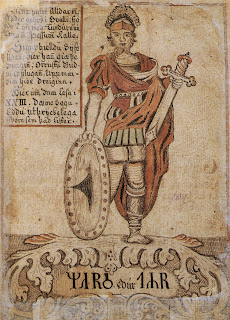 Týr, an Icelandic variant of *Tiwaz.
Something interesting happened in some cases: the name was inherited, but a new meaning was inquired. Greek
theos, Latin
deus, and Anglo-French
divin refer not to particular gods, but to the general concept of a supernaturally powerful person. English, that great borrower of vocabulary, has a number of generic words ultimately derived from
*Dyeus via various paths (mostly through Anglo-French):
deity,
diva, and
divine from Latin, and
theist and
theologian from Greek. My own first name,
Timothy (from Greek
Timotheos) means "god-honorer", but the last syllable is ultimately traceable to
*Dyeus.
(And, yes, it's ironic that I turned out to be an atheist, especially given that my middle name means ... well, more on that in a bit.)The ancestry of our own generic word, god, is a bit murky. All of the Germanic languages have some form like
god or
Gott or
guth, but none of the other Indo-European languages have such a word (with the possible exception of Farsi
khoda). Perhaps its origins are from some obliterated "Old European" language. But a possibly more likely explanation is descent from the proto-Indo-European root
*gheu-, meaning "to invoke", "to pour", or "to offer sacrifice". If so, it may not descend from any god's proper name.
But with the advent of Christianity in Europe,
god underwent the exact opposite transformation that
*Dyeus had undergone. It diversified, going from being a general term to becoming the proper name of a deity:
God, the patriarchal deity of modern Christianity. This usage was, of course, inspired by the usage of the generic Latin word
deus to signify the supreme deity. Indeed, from a purely etymological standpoint,
Jupiter and
Deus Pater ("
God the Father") are the same thing!
Clearly, though, Roman Catholic priests are referring to something different from the chief Olympian god when they invoke
Deus Pater. These supernatural figures have many things in common: power, masculinity, an association with the sky, etc. But they are different in other respects.
Jupiter leads a pantheon of other gods, many of them his relatives.
Deus Pater acknowledges no other gods, and his court is run by lesser beings (angels,
kerubim,
serafim, etc.) which bear no familial relation to him.
Jupiter consorts with humans, even mating with them (lots of them).
Deus Pater is asexual.
Jupiter can be tricked, incited, enraged.
Deus Pater is clear-headed, omniscient, and without fault.
But a look into
Deus Pater's conceptual ancestry shows that those differences are fairly recent inventions. The Christian idea of a single god was, of course, taken from the Judaism. The Judaeans worshiped a single god,
Yahweh, with many of the same attributes as the Christian god: wisdom, power, asexuality, etc. Early Christian sects were divided on how to interpret the single god (or, indeed, if it should be single), but the view that won out was sort of a beefed-up version of
Yahweh (also known as Jehovah, thanks to an interesting clerical misunderstanding that I may go into another time—or you could just look it up).
So where did
Yahweh come from? By the time of the early Christians, he was actually already an amalgam of earlier deities. The amalgamation process began during the Assyrian Empire. When the Assyrians conquered the coastal land of Canaan, they forced many of the Canaanites into exile. A good number headed into the wild highlands occupied by the Judahites, where they were safely out of reach. These Canaanites became known as the Israelites, or
Yishra'eli, the "people of
'El",
'El being the name of their chief, patriarchal god
(whence my middle name Michael, "next to 'El"). The Judahites, or
Yahudi, by contrast, worshiped
Yahweh. Since the
Yahudi and the
Yishra'eli spoke similar West Semitic dialects, their cultures merged, eventually becoming synonymous. As the cultures merged, the gods merged, too.
The Canaanite religion is well-attested from an early (i.e., pre-Biblical) time. The chief god was
'Il or
'El, and he had many sons called the
'Ilohim or
'Elohim. Chief among these were
Haddu/
Hadad (also considered the son of
Dagon, and frequently referred to with the honorific
Ba`al, meaning "lord"), the god of the sky;
Yamm (later dubbed
Yaw), the god of the waters; and
Mot, the god of death (his name also literally meaning "Death").
'El's consort was
'Athtart/
Astarte/
Asherah. This is all necessarily simplified, since various ancient Middle Eastern traditions related these gods to each other a bit differently.
 'El and various beasts adorn the Gebel-el-Arak knife hilt.
The origins of the Judahite religion are not as well known. Canaanites were early innovators of written language
(this Latin script you're reading is actually descended from their script, via Greek script). Judahites, on the other hand, were a bit more backwoods, and didn't produce much writing until later. We know their chief god was
Yahweh or
Yehueh (whence their own name for themselves,
Yahudi, and the later ethnonyms
Judaean and
Jew). Archaeological evidence also suggests that many worshiped
Asherah as
Yahweh's consort. But this is all by a fairly late time. It's tempting to draw an earlier connection to the Canaanite deity
Yaw, or the Hebrew verb meaning "to be", or the Babylonian god
Ea (better known as
Enki), but we simply don't know.
(Then there are the theories linking early Judahites to exiled Egyptian practitioners of Atenism, often cited as the first monotheistic religion, but that's another can of worms.)
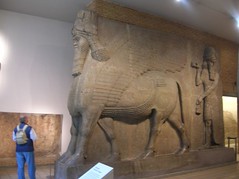
 Sumerian/Akkadian lamassu, the general sort of creature Yahweh would have employed. From the British Museum.
In English translations of the Tanakh (the Old Testament), the chief deity is variously referred to as
God or
LORD or the
LORD of Hosts or
God Almighty or the
LORD God. This reflects several names in Hebrew.
God generally refers to
'Elohim (a plural!) or, more rarely,
'El.
LORD always refers to
Yahweh.
God Almighty is the honorific term
'El Shaddai., and the
LORD of Hosts is the honorific
Yahweh Tsaba'ot. Thus, parts of the Old Testament with the word
God are of Canaanite (i.e., Israelite) origin, while parts with the word
LORD are of Judahite origin. The awkward combination
LORD God reflects a later redaction of originally Judahite sources, a latter-day attempt to secure the synonymy of the two cultures' gods. They hadn't invented parenthetical markers (or, indeed, any punctuation) when these texts were written, but if they had, they might have written it as
Yahweh ('Elohim) instead.
'Elohim, by the way, sometimes is translated correctly as a plural (
gods), wherever it is obviously referring to multiple entities.
 Depiction of a singular 'Elohim creating 'Adam, by William Blake.
In the Tanakh, particularly in the Judahite texts, you can see that the modern Christian
God comes from a rather different source. Unlike
God,
Yahweh is fallible. He regrets his past actions (as in the various versions of the Noachian saga). He can be brought to change his mind (as in the various versions of the Mosaic saga). He has a temper, and it often erupts in genocidal demands. He demands fealty, even unto the killing of firstborn sons (in the pre-edited tale of Isaac). The Israelites and Judahites worship him not because he is perfect, but because he is strong, and will smite their enemies if they cleave to his demands. The differences between
Jupiter and
Yahweh begin to dissipate.
There is still the matter of sexual voracity, though. Although
Asherah was worshiped as
Yahweh's consort by the people, the priests tended to revile this worship, and hence no mention is ever made of any sexual proclivites in the Tanakh. There is a passage where the sons of the
'Elohim mate with human women, producing the heroes of old (shades of Hercules!), but that's about as close as it gets. In terms of character,
Jupiter and
Yahweh are not dissimilar, but
Jupiter is more of a lover and
Yahweh is more of a fighter.
(How odd then, that it was the Greeks and Romans who conquered the Judaeans, not vice versa. But I digress.)
 Jupiter gets some attention from Thetis, by Jean Ingres.
So, like many cultures, ancient Semites and ancient Indo-Europeans revered mighty, patriarchal chief gods. These chief gods lead pantheons of lesser gods. They sometimes made mistakes. And, while often generous to their followers, on occasion their behavior can be described in no other way than evil.
(Indeed, some early Christian sects believed Yahweh to be an evil deity, inferior to the beneficent 'Elohim.) In essence, these gods were big, powerful men, not the ethereal, cerebral force that
'Elohim and later
Deus Pater became. As the civilizations evolved, so did the gods.
By now it should be clear that tracing these divine genealogies can get pretty complicated. My attempts to synthesize a nice, clear chart have so far failed. But I'll keep at it.